Showing posts with label Vegetarian. Show all posts

Tuesday, January 3, 2012

Rogue Creamery Smoky Blue, Making a Believer Out of Me

Dear Reader,

Something you may or may not know about me is that I am not a huge fan of "smoked flavor" foods. This merits some clarification, so let me assure I do in fact like smoked meats. I will eat smoked pork all day and be a happy man, smiling my way right into a heart attack. What I don't like is smoked flavor on foods that should not really be smoked. The greatest and most notable offender here is, yes dear reader I'm going there, the humble cheddar. I have yet to find a smoked cheddar that is anything but a subpar cheddar with some bleh smokiness added to it, adding up to nothing at all. Low quality smoked salmon? So gross. Smoked chevre? Why? The sickly sweet and sticky texture and flavor that accompany most run of the mill smoky-whatevers is just rubbish. Through and through. That's assuming the initial product was any good, and we all know that's wishful thinking.

So.
When I saw that Rogue Creamery, legendary for their blue cheese range, made a smoked blue... I was skeptical. Friends, comrades in curds, caseophiles, I am hereby admitting to having found a truly delicious smoked cheese. Smoky Blue is a good cheese, a good blue, and a good smoked. It is a good. Good.
Origin: USA, Seattle Washington
Milk: Cow, unpasteurized
Rennet: V-v-v-v-vegetarian!
Affinage: 4-6 months
Notes: Cold smoked for 16 hours over hazelnut shells. What you know about a next level hipster smoking process?
Thoughts: Imagine a strip of bacon. Now imagine you’re dunking that strip of bacon in gorgonzola and eating it whole. You’re now getting a bit of an idea of Smoky Blue. The smoke, while definitely present both in aroma and flavor, is not in any way overbearing or artificial. Instead it is rather subtle and develops over the course of the flavor, constantly playing off the understated bite of the gorgonzola and carried perfectly by a carefully balanced creaminess. 


The Cheese Manifest, Cheese List, and Cheese photogallery of the FCA are all up to date and ready to start churning out misguided posts again, hope you all had a lovely Christmas/Holiday/Standard day of the week. 
 

Saturday, October 29, 2011

Ewephoria, See What They Did There?

There are some traditions as old as the hills. 
The Gouda masters of Holland are the keepers of some such traditions, and naturally they are the last word on Gouda production. This cheese is not one of those traditions.
Aimed pretty shamelessly at the export market, Ewephoria joins the ranks such as Soignon goat brie and Cambozola in letting flavor follow market demands. While those two cheeses are mediocre if forgettable Frankensteins (or Frankenstein's monsters, if you're a purist), Ewephoria is actually pretty good. You know, dear reader, how I protest against such prostitution of palate for profit, but here's one example that stumbles upon a decent idea and executes it brilliantly. 
Origin: Holland
Milk: Sheep, pasteurized
Rennet: Microbial
Affinage: 6-12 months
Notes: There are a few different ages available, but who are we kidding. Why go for mild and meh when you can have a Gouda that screams unintelligbly in Dutch at you. Doesn't that sound like more fun?
Thoughts: This adaptation on Gouda has a pleasant flavor that develops over the course of the taste. At first the cheese starts out with a mild nuttiness and a hint of sweetness, by the end the sweetness has developed into a rich and dark toffee/butterscotch note that breaks down perfectly on the palate. This sweetness is highlighted and contrasted by the natural oiliness of the sheep's milk, which makes for a complex but not overbearing overall taste. Not too creamy, but balanced, this is a great interpretation of the classic Gouda and well worth trying for any Gouda lover. 


What is fascinating is the contrast between the characteristics of sheep's milk from Spain and that from Holland. I mean, barely 1,000km apart and they could be two completely different animals, for example there is nothing olive-oily about this cheese, but you can practically taste it in a lot of the Spanish sheep's milk delicacies. Does no one else find this really exciting? Am I all alone in the universe?


Saturday, September 3, 2011

Red Dragon, Now Without Hannibal Lecter

Get it? Like the movie? Oh the humor.
Just like the dark hero/villain of everyone's favorite serial killer series, today's cheese is both sophisticated and stylish while still being fiery and ruthless. Ok, maybe ruthless is pushing the boundaries of acceptable adjectives for food stuffs, but bear with me and you'll see just what I'm talking about.
Red Dragon is, in this humble blogger's eyes, one of the more delicious cheeses to come out of Her Majesty's pastures. I have before decried the evils of adding blah extras to blah cheese and ending up with a blah product, but today's addition passed the delicious exam. A tough exam at that.
Origin: England
Milk: Cow, pastuerized
Rennet: Vegetable
Affinage: 3-5 months
Notes: The proverbial fire behind the proverbially red dragon's proverbial breath here is a potent cocktail of brown ale and whole mustard seed. For those of you keeping track at home that makes the score delicious.
Thoughts: In appearance it might resemble Leyden of posts past, but do not be deceived like so many greenhorns on the pilgrimage to cheese paradise. It's flavor profile, surprisingly unhindered in texture by the whole mustard seeds, is full, bold, and unashamedly English. The mustard seed definitely takes the lead role here, providing a steady and complex heat throughout, but the ale makes its own cameos here and there, poking through as it were to make its meaty and sweet voice heard. A subtle moistness in the paste begs to be cut into small slices and savored, and indeed even a small piece of this cheese will carry all of the delectable flavor. The cheese itself, unquestionably the shy flavor of the group, is however present in the creaminess and ever-present base upon which the others build their house. Flavor house. You know the one.


Take heart fellow seekers of the killer curds!
Things here at Functioning Cheese Addict have been taking a relative back seat to classes and life's other slings and arrows but as the dust begins to settle I bring tiding of great cheese. Soon I will once again be gainfully employed in the great cheese hall of Longmont Cheese Importers in Colorado, so I might just start posting cheeses you can actually find in the US again. 

PS If you're reading this from across the sea and the novelty of being able to find European cheeses strikes you as old hat, just pause and be thankful for your geographic good fortune. Eat some real French Brie for your brethren here in the USA, suffering as it were under the yoke of USFDA pasteurization laws. 

Friday, July 29, 2011

Saxony, Wisconsin Proud

Another notable cheese from the Badger State, love the nickname, Saxony is a cheddar-esq table cheese that proves American cheeses can still have some of the mojo of the Old World. This is a cheese that tastes decidedly of Europe, thanks in part to it's being made of raw milk and in part to the history of the dairy, Saxon Homestead Creamery. 
5 generations ago, in 1848, a family moved from the Saxony region of Germany to America in search of new opportunities. It was an exciting time in still-young America; Wisconsin had just become a state, we were at war with Mexico, and soon there'd be both a president named Zachary and a gold rush in California. This particular family, however, understood that the true gold lay not in the ground, but in the grass. Not in the dirt but in the delectables. Not in that which shines but in that which satisfies! 
The first cheeses started being made, if perhaps not commercially sold, in 1870, and now look at them. Officially entering the cheese scene in 2007, their raw milk selection soon won them considerable acclaim. Also, they have a website. We should all start dairies. I want a website.
Origin: Wisconsin, USA
Milk: Cow, unpasteurized
Rennet: Microbial
Affinage: 90-150 days
Notes: The rind is embossed with the name of the cheese and the logo of Saxony Homestead Creamery, which is all great sure but if Gordon Ramsey was cooking me a steak I wouldn't want his face branded on top. Yeah?
Thoughts: Like a tart cheddar, drawing heavily on the influence of Saxon and French style aged raw cow milk cheeses, Saxony starts quiet but has a rich and nuanced flavor from the very beginning. The raw milk really features here in all its flavor-giving goodness, relatively unbothered by either an overpowering creaminess or competing tones. A grassy undertone does, however, permeate the flavor and the mild bitterness builds up strongly for a rich finish. Not what I'd call a powerful or sharp cheese, but it manages to be sophisticated and delicious in all its mildness. Impressive.


Caution Random Thought To Burden You Further With
The alt-text to the last sentence in paragraph 2 reads "... which solidifies into curd which can then be molded into wheels, salted, and aged for consumption". A different kind of poetry, really.

Saturday, July 23, 2011

Coupole, Because Goat Cheese is Underrepresented on this Blog

In fact there're about twice as many cow cheeses as goat cheeses here, but then about twice as many goat cheeses as sheep cheeses. A grave injustice for another day. 
Vermont Butter and Cheese Creamery has featured once or so before with their surface ripened goat cheese creations and today we see another, bigger example; Coupole
Origin: Vermont, USA
Milk: Goat, pasteurized
Rennet: Vegetable
Affinage: 45 days
Notes: The rind is sprinkled with ash, it has 21% fat per solid content, and no that mold is not dangerous. It's delicious. 
Thoughts: The first impression from this cheese is the pure smooth creaminess and the strong but not harsh goaty flavor. The entire bite, rind and all, has just enough difference in texture to be complex and interesting without ever being disconcerting, instead a strong unified flavor grows over the course. The cheese melts in the mouth midway through and is almost sweet towards the end, leaving a very pleasant and buttery aftertaste.


Caution
It doesn't hurt to ask the stout yeoman behind the counter if mold should or shouldn't be on a cheese. Just don't go crazy and try to get the place condemned, cheese will mold as surely as dogs will bark or haters will hate. Fact o' life. 

Wednesday, July 20, 2011

Soignon Goat Brie, More Marketing Madness

Here again we find a cheese that owes its existence to the mighty power of the Dollar. Or actually the Euro. Made by French cheese giant Soignon, this cheese is just what it says it is, a brie style cheese that uses goat milk. It practically reviews itself.
Origin: France
Milk: Goat, pasteurized
Rennet: Vegetarian
Affinage: ~2 weeks
Notes: 30% fat content and a burning jealousy of all the attention Brie de Meaux receives.
Thoughts: But not really. On the one hand this cheese is pretty blatantly not trying to compete with real-deal Brie, and on the other it actually is a massively popular seller. Stack it up on a shelf with a sample in front of it and it'll sell like foil hats at a Tea Party convention. Why? It actually tastes decently good and sticks to its strengths. Goat's milk is by nature very sweet, so what better than to make a creamy sweet brie out of it? Undertones of that clean grassy tang come through now and again adding depth but the dominant impression is the rich sweetness. Not altogether bad for a corporate ploy.


Caution
If you or your friends are disgusted by the thought of goat cheese and would rather stay stuck in your ways than branch out, avoid this cheese. 

Sunday, June 26, 2011

Point Reyes Original, Big Fan

I have already spent much time and ink (or not really ink but energy I suppose) extolling the virtues of the artisanal cheese movement in California and the many exquisite cheeses that come from it. Today's is yet another example of excellent Californian cheeses, this time coming from the Bay Area of San Fransisco. The Point Reyes Farmstead Cheese Company is a powerhouse in the high-quality cheese scene, it's masterpiece the Point Reyes Original blue. 
According to the website, the secret to their recipe is the top notch milk from their Holstein cows, the coastal fog, and the salty sea air. There must be some sort of 4th secret that they're not sharing with us, though, because it really is a killer paste. The cheesemaking process starts only a couple hours after the milking, and from these fresh beginnings the quality is maintained at the highest possible levels. Penicillium Roqueforti, as is used in so many other great Blues, is introduced to give it its lovely veining. This is a American treasure, to be sure, and is as worthy a cheese as has come out of the good old USA. 
Origin: California, USA
Milk: Cow, unpasteurized
Rennet: Vegetable
Affinage: 5-6 months
Notes: Looking for a really cool holiday? Go to San Fransisco and make a mini cheese pilgrimage out to the Point Reyes farm, great scenery, hiking, and incredible cheese!
Thoughts: This blue is the full deal. The first taste is creamy with just a hint of the bite to come, but the overall effect is far more complex than just another staple blue. As the flavor develops a rich dark, almost smoky flavor appears and is followed closely by a sharpness that is bold without being harsh.The rich and even veining lacks the sometimes over-salty mineraliness of some European Blues, and while it definitely is less offensive to the tastebuds than a Roquefort or Cabrales it is by no means a lightweight, Point Reyes Original means business. It is very versatile in that it is rich and strong and can stand alone by itself on a cheese platter but is not so overpowering or harsh that it can't be used in recipes, in fact it is a great addition to any salad and a favorite for me alongside steak off the grill. Point Reyes Original Blue is a cheese to be truly proud of, so perhaps this 4th of July go and celebrate (if you're an American, I suppose) with a hearty wedge of this all-American cheese! 


Caution
Not that I condone ultra-nationalism, or any ism for that matter. Isms in my opinion are not good. A person should not believe in an ism, he should believe in himself. I quote John Lennon, "I don't believe in Beatles, I just believe in me." Good point there. After all, he was the walrus. I could be the walrus, I'd still have to go without basic groceries to afford fine cheese.   

Thursday, June 16, 2011

Sage Derby, Or As I Was Saying

Right, so I went on for a little while in the last post about the evils of sub-par or forgettable cheeses with some infused flavor passing off as worthwhile standalone cheeses. Same story, different day. Again, today's cheese isn't even necessarily bad, it will add color to the plate, it will attract attention, it will peak interest, but novelty factor alone does not earn one a place in the Favorite Club. 
Originally made just around Christmas time, Sage Derby is one of the older infusion cheeses to come from England, where the digestive properties and festive look of the green sage made it a hit on holiday tables. Plain derby is not as commonly found outside England, which works fine with me as it's effectively just a younger, milder, buttery-er cheddar.... and who among us wasn't thinking "gee this mild cheddar is just too sharp, it sure could use a little less flavor and a slightly heavier presence on the palate."
Apparently I'm biased, go figure. Macerated sage leaves, sage leaf essence, green food coloring, or a mixture of these are used to create either a uniformly green paste such as the one pictured below or a more marbled look similar to the Porter Cheddar but in light green. Adding color and things to a forgettable cheese is like adding racing decals, spoilers, and louder exhausts to beater cars.... if you start with rubbish you're going to end with rubbish.
Origin: England
Milk: Cow, pasteurized
Rennet: Vegetable
Affinage: 3-4 months
Notes: I come across as pretty one-sided when it comes to English cheese, but there are some seriously incredible creations to be found. There's also a lot that's just not worth buying twice.
Thoughts: The sage flavor in this cheese, grassy and tingly as if a little minty, overpowers any flavor the Derby might have had, though we'll never know now. The creaminess and the texture of the cheese do come through, though all they really convey is the novelty flavor and no real depth or character of flavor. All this being said it's a huge hit among those looking for a new snacking cheese as well as small children. The issue I take here is that there are so many cheeses, mostly sheep's milk cheeses but also from cow and definitely from goat's milk, that have a natural grassy and green flavor to them with all the depth and character you could want, just as a result of being carefully and traditionally made from top quality milk. Just saying.


Caution
Dear UK readers; I'd love to sit down and share in some Port and Stilton with you as we discuss the virtues of your cheeses, for there are many. Please don't be cross, I don't spare other countries when they make bad cheeses either. The USA especially.

Wednesday, June 15, 2011

Barely Buzzed, Not Actually a Reference to Alcohol

Every now and then you hear about a cheese that sounds, well, gimmicky. Like a little too much work went into the concept phase and not enough into the actual making of the cheese itself. I would say that this trend, especially as it applied to Cheddars such as today's piece, began with the adding of all manner of spices and other sundry bits to what's basically an English Cheddar and calling it things like Cotswold. Don't get me wrong, Cotswold is great stuff and one of the tastier snacking cheeses out there, but many of these cheeses, especially from her Majesty's territories, suffer from being too much added nonsense and not enough good honest cheese to start out with. This will not do.
With that foreboding introduction let us look at Barely Buzzed, a Cheddar from interior of the US that incorporates ingredients from as far away as Turkey and France. I think. It is made in Utah and rubbed down with a mixture of Turkish coffee grounds and French lavender buds, giving this otherwise normal recipe cheddar a whole new spin. But is it good?
Origin: Utah, USA
Milk: Cow, pasteurized
Rennet: Vegetable
Affinage: It's a young cheddar, in the 6 month range I'd say.
Notes: Aged on Utah Blue Spruce aging racks. When I get around to making and aging cheese I'm going to either age it on something really pretentious or really ridiculous, not sure which yet. I'm thinking either boards ripped loose from the ballroom floor of the Titanic or Legos.
Thoughts: Not surprisingly, the flavor the coffee and the lavender gives the flavor of the cheddar a run for its money. The cheddar, by itself not particularly strong or sharp, comes through only just barely alongside the thick coating of espresso and lavender. The taste is unlike anything else and almost belongs to a different category altogether, but is savory and peculiar enough to keep you coming back. My complaint here is that there just isn't a whole lot going on flavor-wise to catch my interest apart from the obvious coating, which is never going to be enough to prop up a cheese by itself. Give me a strong or memorable flavored cheddar and then coat it with this or that or the other but not before. It is a great party piece, it is an interesting excercise in flavor combination possibilities within a single cheese, it is not even a bad cheese, it's just so much less than it could be. 


Caution
If something seems too good to be true, it just may be. The Prince from Nigeria only wants your money, you're not actually the 1,000,000th visitor to the site, your friends on Facebook did not actually get a free iPad 2 just for completing a survey, and not all that sounds funky on a cheese label is gold. 

I feel like that one got away from me at the end there...  

Saturday, June 11, 2011

Billie's Goat Cheddar, Another Too-Cute Goat Cheese

England is mostly known for its heavy cow cheeses, mixed perhaps with spices or onion or some sort of alcohol, and while this can be very good it also gets a little... a little too monotonous for me. Enter Ford Farm, the folks who brought us the Coastal Cheddar of a couple weeks ago, and today a nice departure from the bovine; their goat's milk Billie's Goat Cheddar.
Made with the same quality control measures and attention to classic English cheddaring technique as their more traditional offerings, this goat cheddar is refreshing and, though young and thus mild, very tasty indeed.

Origin: England
Milk: Goat, pasteurized
Rennet: Vegetable
Affinage: 2-5 months
Notes: Website advertises a mild, mellow, and smooth flavor derived from 100% pure goat's milk. Good thing they fished those twigs, leaves, and other impurities out of the milk before making cheese. I wonder if they sometimes get a little laugh by slipping some cow milk in there and pulling a fast one over on us customers thinking we're purchasing a goat's milk cheese when the name is Billie's Goat Cheddar. 
Thoughts: Although the flavor is certainly more mild than I usually go for in goat cheeses, this cheddar displays some of the complexity possible in a goat cheese. At first a little meaty, the creaminess of this relatively soft cheese comes in midway through the bite and leaves in its wake the delightful sweetness of goat’s milk. A very un-goaty goat cheese that leaves more of the sweet on the palate than the savory, it certainly is smooth, mild, and mellow. Once could go much worse in purchasing mild-aged goat cheeses, Billie's Goat is an example of mild done right. With some fig jam or a fruity red wine it's truly a delight. 


Caution
I do not actually think the professionals at Ford Farm are in the business of hoodwinking, bamboozling, or hornswoggling their customers, I just find the proud profession that their goat's milk cheese is made with none other than goat's milk to be kind of like bottled water having an ingredients list.   

Saturday, June 4, 2011

Haystack Peak, A Longmont Treat

Another cheese coming from the Haystack Mountain Goat Dairy (now with newly updated website); today's goat-milk offering is an example of how a mild cheese can be done right. It is made in molds at the busy pasteurized milk room of the dairy and then carefully watched and tended as it ages. Haystack Peak is a surface ripened goat cheese, in the same way that Humboldt Fog is, so the flavor and textures are nuanced and vary greatly with age, making for an overall versatile and delicious product.

Origin: Colorado, USA
Milk: Goat, pasteurized
Rennet: Vegetable
Affinage: 3-4 Weeks
Notes: A bloomy, surface ripened goat cheese with vegetable ash in the rind. Will continue to ripen until you cut into it, making for a flavor that can vary from very sweet and milky to a richer goat's milk tang depending on the age. 
Thoughts: I really wanted to title this post "Haystack Peak, a Mountain of Flavor", but that would be 1) a really really bad play on words and 2) just not entirely true. Do not fear, however, because Haystack Peak does mild in a way that keeps you wanting more instead of just getting bored. A light and airy delight, the flavor is here and it is good. One bite comprised of the sweet and cleanly grassy fresh chevre-like interior, the slightly stronger but still milky creamline, and the bloomy/ashy white rind is an experience not to be missed. The tangyness of the rind is just right and there is never that hint of ammonia that so often accompanies surface ripened cheeses. The three distinct textures combine beautifully for a very refreshing departure from the everyday chevre. It pairs nicely with all sorts of fresh fruits and even has enough complexity to the flavor and texture to be eaten by itself. 
Caution
At room temperature this one's a bit messy... in the best possible way. Keep it on a plate and loosely covered while it's warming to keep it from drying out and keep those baguettes on hand for delicious delicious damage control once you cut into it. 

Wednesday, June 1, 2011

Vella Dry Jack, As American as Apple Pie

As a melting pot, land of opportunity, enter other overused cliche for the USA here, we have ended up making our own versions of cheeses from hither and yon simply as a result of where our citizens have come from. Sometimes we get a bad rap for this, something about a lack of creativity or something.... I don't know. Regardless, what we have here today is not an American-made cheddar, an American-made brie, or and American-made anything from the Old Country. What we have here is full on, bleeds red white and blue, Chuck Norris and Bruce Willis approved American. It even has a long form birth certificate. 
Jack (see Monterey Jack, Sonoma Jack, or today's Dry version) is a true American original, created in the 1890s in California by a one David Jacks. Most versions are soft and very young, but today's is a little more notable than your average grocery store variety. Vella Dry Jack, the Bear Flag Label variety reppin' California cheeses, is an aged version with an appropriately different texture and flavor. 

Origin: California, USA
Milk: Cow, unpasteurized
Rennte: Vegetable
Affinage: 7-10 months
Notes: Has won awards both domestically and internationally for it's exceptional character and flavor. Natural rind coated with oil, black pepper, and cocoa powder to seal the cheese without imparting an overpowering flavor.
Thoughts: This cheese is unapologetically nutty and rich. The flavor is never too intense but is consistently dark, salty, and savory, and even though it is truly very dry the flavor more than makes up for the lack of creaminess. The cocoa on the rind adds a perfect hint of sweetness that works off the grassy, nutty flavor and as the cheese crumbles in your mouth the complex flavor hits all at once. One of the highlights of this cheese is the aftertaste, however, which is remarkably meaty and grassy.
Caution
If you live in or even near Sonoma County, California you literally have no excuse not to stop by and visit the Vella family business at work. They are true American masters of their craft.   

Tuesday, May 31, 2011

Old Quebec Vintage 3yr Cheddar, Winner of the Most Descriptive Name Award

Today's cheddar.... yeah it's from Canada and it's aged at least 3 years.
Actually there is a little more to this cheese than what stands in the title, but I think they were running out of space. Like the label says it is "Super Sharp" as well, but don't be fooled; this is not a cheddar that tries to stand on its sharpness alone. Made using milk that has been heat treated but not pasteurized, a process carefully described at the company's utilitarian website, Old Quebec Vintage 3 yr Cheddar truly has a complex and solid flavor, an outlier in the rather crowded cheddar field.

Origin: Canada
Milk: Cow, unpasteurized 
Rennet: Microbial
Affinage: At least 3 years, less than 7
Notes: The 3yr cheddar is at least three, the 7yr at least seven, but what they don't tell you is that they actually do the majority of the aging in Lancaster County, PA. Conspiracy?
Thoughts: From the first the flavor has a pronounced meaty and salty tang, a refreshing change from the one-dimensional sweet tang of most cheddars. The age has made this a rather crumbly cheese but still it is impressively creamy, and once the paste breaks down on the palate more the familiar sweet notes are right at home, played off of by the occasional caramel note. The sharpness of this cheese, while certainly there and a major factor in the overall flavor, comes short of overshadowing the other nuances of the flavor, and the result is a fully developed taste that is sure to please. Although this feature is more apparent in the older variety, even at 3 years the calicum casein clusters are already a delight and add just more character to an already impressive cheese.

Caution
If the Canadians and the Amish ever start working more closely together we in the USA might have a crisis on our hands. That concentration of niceness and accents can only mean one thing: violent revolution. 

On a separate and non-link-related note, did you know that when you google image search "Amish Army" there aren't actually any funny pics? Pity, really. 

Saturday, May 21, 2011

Bijou, A Little France, A Little Vermont, A Lotta Flavor

In the emerging but already hip field of American goat cheeses there is a good deal of innovation and quite a few excellent examples both of fresh chevres and their surface ripened counterparts. One thing that the artisans in the US all share, however, is their respect for the French mastery of making delicate and delicious goat cheeses, a tradition as ancient as the hills of Périgord. For this reason many of the best producers in the US have studied French methods and technique, the results being cheeses such as Cypress Grove's outstanding lineup.
On the opposite side of the country there lies another dairy with an acute appreciation for French cheesemaking, the founder's love of cheese was sparked while staying with a host family in France and helping with their trade. Allison Hooper of Vermont Butter and Cheese Creamery creates delicate and refined cheeses and other dairy products such as today's Bijou, French for Jewel. Its name describes it well, a small crottin-style cheese full of flavor and nuance.
Origin: Vermont, USA
Milk: Goat, pasteurized
Rennet: Microbal (vegetarian friendly)
Affinage: Varies by preference, mine were in the 1 month range
Notes: 21% fat per solid matter, these little guys come two to a package and really are just adorable. You'll want to pop it like candy, but good things come to those who wait. Especially if they're waiting with baguettes and some dried cherries.
Thoughts: At this age the Bijou displayed a relatively reserved goat flavor, instead showing off it's butter-like creaminess. Cutting into it reveals a uniformly smooth paste and the sweet and milky tones characteristic of young goat cheeses, with the usual tang of the goat's milk present throughout but notably muted. At room temperature it spread beautifully and even the smallest bite carried fully the flavor and bold texture. The rind, which displayed small patches of green-blue molding, added both a pleasantly contrasting textural chew and a slightly sharper goat flavor. 


Caution
Each little button being self-contained means that Bijou will ripen until you cut into it. Fortunately it, and it's cousins from Vermont Butter and Cheese Creamery, is as delicious in its young, delicate stages as in its pungent, sharp age. 

Saturday, May 14, 2011

Red Cloud, The Poison Dart Frog of Goat Cheeses

Except this little guy is only warning you of the intense flavor and aroma instead of, you know, poison.
It's a Goaterday miracle!

Haystack Mountain Goat Dairy, whom I had the pleasure of working for during the summer of 2010, boasts a wide range of handmade goat and mixed milk cheeses. A proud staple of it's Longmont community, Haystack has been making cheese since the late 1980s when it started out as a small farmstead operation. Today they have widespread recognition both in Colorado and nationwide and a number of well-earned awards hanging on their wall for their offerings such as today's Red Cloud. Named after one of Colorado's famed 14ers, or mountain peaks over fourteen thousand feet (4.2km), it is a washed rind specialty made with raw milk; a recipe for truly intense flavor.
Origin: Colorado, USA
Milk: Goat, raw
Rennet: Vegetarian 
Affinage: 60 days
Notes: Seriously, this cheese stinks! What is a major issue in primary school, however, is less of a putdown and more of a temptation on a cheese plate. Just keep it separate from other cheeses, it still doesn't play well with others.
Thoughts: Once you screw your courage to the cheese-eating place and take a bite, you are instantly rewarded with a bold and complex flavor. A very rich creaminess washes tones of the usual goaty sweetness over the palate at first, but this quickly develops to reflect the raw milk and the washed rind. That particular tang that is so unique to raw milk cheeses is displayed beautifully here and plays perfectly off of the meaty, fruity tones from the washed rind. Every flavor in this cheese comes on strong and yet they maintain a healthy balance throughout making for a very addicting, if slightly breath-souring, experience.

Caution
"slightly breath souring" is a bit of an understatement. It's like saying Obama "kind of poked fun at Donald Trump" in his White House Correspondents Dinner speech. Actually, this cheese will wipe the proverbial smug smile and self-righteous attitude right off your proverbial ridiculous-hair topped face and leave it griping the next day to its proverbial support base of business elites. 

eh-ehm...

What I mean by that is it's a very smelly, very strong cheese and you should probably put off your first-kiss plans with little-miss cutie (little-mister dapper) until you've gargled, flossed, and brushed. Twice.

Saint André, (See Cheesecake)

Right, so first things first. The astute and devoted reader of this blog will have noticed with the greatest of disappointment that there was no blog post yesterday. Blogger, the device through which I disseminate this dastardly delicious dossier, was effectively down for the better part of two days, rather throwing off the whole cheese-a-day scheme. No matter, for today you get three posts! One for today, one for yesterday, and a third because, who am I kidding; I thoroughly enjoy writing these.

Perhaps the biggest problem with bringing the great cheeses of Europe to the non-European table is the issue of quality control. The industrial revolution had devastating consequences for genuine cheesemaking traditions in Europe, but while the good stuff can again be found on a small scale the same cannot be said for what is exported in bulk. As a result we have cheeses such as today's Saint André; a cheese with flavor, texture, and good looks, but lacking a soul.
Origin: Normandy, France
Milk: Cow, pasteurized
Rennet: Vegetable
Affinage: Roughly 30 days
Notes: Here we see our first fake leaf, and even though this cheese is legitimately from France it still suffers from being, well, dumbed down for export. French cheese importing giant Ile de France is probably responsible for most of the French cheeses available at your supermarket, but for all the good they have done in spreading the word it has come at the cost of integrity of the cheese. Sure we can get Fol Epi, Saint Agur, Bleu d'Auvergne and other cheeses of French origin, but they are typically only facsimiles of the original. Worse yet, real-deal cheeses are often discontinued domestically to favor the more profitable export of these pseudo-cheeses. Oh PS it's a triple crème too.
Thoughts: The first thing you'll notice about this cheese, once you remove the paper leaf, is the texture. It is surprisingly dense for a triple crème, so much so in fact that it will hold its shape even at room temperature. Unfortunately, with the supermarket cheesecake-like texture comes a supermarket cheesecake-like flavor. While obviously very rich and creamy, Saint André is otherwise underwhelming. It is sweet and slightly salty but otherwise pretty one-dimensional. This combined with the dense texture means that it does not cover the palate as evenly as some smoother cheeses and, overall, there are just better "dessert bries" to be had. Don't get me wrong; this is not a bad cheese, and it will certainly be a crowd pleaser alongside sweet fresh fruit, but it lacks soul. The original notes from my tasting read "flavor is good but not incredible", and really it could be so much more.

Caution
Going the extra distance for the true essence of that one French Cheese might just mean flying to France for it. On the other hand, dairies in the US are making ever-better originals, and why pass up the cheese tours right in your backyard?  

Saturday, May 7, 2011

Humboldt Fog, Reason Alone to Visit California

It's no secret that Cypress Grove holds a nearly cult-like following among goat cheese enthusiasts (I like how saying 'goat cheese enthusiasts' makes it sound like it's a normal, established thing), and this fantastic addition is undoubtedly the primary reason. One of the earliest and most widely acclaimed examples of America's "Cheese Renaissance," Humboldt Fog is the crown jewel of Mary Keehn's impressive cheese empire. A surface ripened disk with an unmistakable grey rind and a layer of vegetable ash down the center; it looks very much like a decadent layer cake and the flavor is no disappointment. This is one of those cheeses I've been wishing I could find in small-town Germany. That good. 
Origin: California, USA
Milk: Goat, pasteurized
Rennet: Microbial, (vegetarian friendly)
Affinage: ~6 weeks, ripens until you cut into it.
Notes: The layer of ash down the center of the paste is a throwback to the old cheeses of Europe such as Morbier. The morning milking curd was covered in a layer of ash to preserve it until the evening milking curd was put on top. Also, it seems I couldn't quite wait to start eating this wedge before I photographed it. Whoops.
Thoughts: Shall I compare thee to a Summer's day? Thou art more easily spread on baguettes and infinitely more delicious than rough winds or darling buds of May. There are loads of decent but ultimately forgettable surface ripened chevres out there, but Humboldt Fog truly stands apart. The flavor is, from the start, complex and dynamic, proof that with age comes fromage's equivalent of wisdom: sophistication of flavor. The rich, truly-cake like, paste comes on strong with sweet, grassy, mushroomy tones from the very beginning, and the intensity just builds alongside the full creaminess of the milk. The creamline, just below the rind, was encroaching slightly on my more aged piece, but while the paste is perfection the creamline still has something to add. Smoother and tangier than the already smooth paste, it adds a faintly spicy tone to the experience and, when rind, creamline, and paste are eaten together, it's a quick view of cheese heaven. Alternatively you buy a whole wedge (or a whole wheel!!!) and you get a slightly longer view of cheese heaven.
This cheese deserves every bit of praise, and indeed every award, that is has received, but the true testament to Cypress Grove is that they have even better offerings waiting to be discovered. Stay tuned. Humboldt Fog should be fairly easy to find in the USA, with specialty cheese stores and a growing number of "natural" supermarket chains carrying this cash cow (Gold Goat?), and it will absolutely disappear from any cheese platter. Impress your friends, indulge your addiction, buy a wedge and see why so many people swear by Humboldt Fog.

Caution,
There are those who, when they are enjoying the festivities of a cheese party, will attempt to carve the paste out of every cheese and leave the rind on the plate. This is cardinal sin with Humboldt Fog, as the rind is truly so well suited to the paste the two need never be separated. Offenders shall be prosecuted. The Acquitted will be subjected to double jeopardy. The twice-Acquitted will be made to watch Double Jeopardy.  

Saturday, April 30, 2011

Cabra Romero, Because the World Needs More Lard

First and foremost let us rejoice! Today is the first Saturday of the cheese-a-day marathon, meaning I'm arbitrarily starting a tradition of posting goat cheeses every Saturday! I understand starting new traditions is textbook power-going-to-head behavior, but I love goat cheese, I've got more goat cheeses on file than anything else, and these reviews aren't going to post themselves. Submit your ideas of what goat cheese Saturdays should be called in the comment section and I'll choose whichever one strikes my fancy. Maybe there's a prize involved. Like a video-singing-telegram. From me. 

Murcia must have some of the tastiest meadows around because this plucky region of Spain just keeps the cheese hits coming. Cabra Romero is an aged but very moist goat cheese created by a one Lorenzo, who ages this treat for 2-4 months, uses microbial rennet and, oh yeah, covers the rind in lard and then presses each wheel in Rosemary before shipping. 
Origin: Murcia, Spain
Milk: Goat, pasteurized
Rennet: Microbial (vegetarian)
Affinage: 2-4 months
Notes: One of the more sickly satisfying jobs at the Cheese Importers was brushing (prying really) the lard and rosemary mixture off of the rind before giving it out as samples or on cheese platters. You know no one's compromising on flavor when lard is employed.
Thoughts:  This fruity and herbal goat cheese has as intriguing and complex a flavor as only a cheese rubbed in lard could. I mean that in the best possible way. The grassy, fruity essence of the rosemary comes across strong at first but the goat's milk flavor quickly builds into a perfectly sweet and creamy delight. The rich savoriness of the lard is clearly present and carries throughout the taste but does not overcome the complex flavors that develop over it. This cheese is one of the few aged, semi-hard cheeses that I prefer to eat on slices of baguette, as it seriously is so buttery in flavor that you'll want to try to spread it. A bold flavor backed up by an equally bold texture and a near-reckless devotion to gastronomic indulgence earns this cheese a spot in my top 5.

Caution
If no one submits name suggestions then everyone gets singing video telegrams.

Tuesday, April 26, 2011

Cashel Blue, The Dropkick Murphys of Blue Cheese

The main differences being that the Dropkick Murphys are musicians and Cashel Irish Blue is, well, from Ireland. Beyond that Cashel Blue actually has quite a few things in common with everyone's favorite Irish-American punk band; it is a gritty, unrefined, and generally bold cheese that, despite all this, always seems to be in season.
Origin: Tipperary, Ireland
Milk: Cow, pasteurized
Rennet: Vegetarian friendly
Affinage: 6-12 weeks
Notes: Uses the same Penicillium roqueforti strain of mold that's found in France's Roquefort and a previous star of our show, Rouge River Blue. Husband and wife team Jane and Louis Grubb have been making this cheese since 1984 in response to the lack of artisinal Irish blue cheeses, and though Cashel Blue is now shipped across the globe in ever increasing quantities, production remains in the hands of the family and their team. Say it with me now; "d'awwww".
Thoughts: The sample that I came home with was on the more aged side of its lifespan, meaning that instead of a creamy, crumbly Irish Terrier of a cheese I unwrapped a veritable Wolfhound. This older variety maintains it's rich texture but is characterized by an intense and salty grit, the two factors seemingly fighting for dominance and, in the end, making for a balanced but intensely potent cheese. As will happen, Cashel Blue grows soft in it's old age; it's moist and milky paste delivering the formidable bite of the Penicillium veining perfectly and all accompanied by an aroma to match. Perfect spread on anything or cut with some sweet dried fruit, Cashel is great for the blue cheese enthusiast looking for a mightier mold.

Just a quick word on mold while we're on the topic, as goodness knows I may never post another blue/molded cheese and I'd hate to miss this chance. If you think cheese with mold in it, around it, or through it is a frightening/disgusting proposition, allow me to respectfully disagree.
See, here's the thing. Cheese is, for all intents and purposes, curdled milk that has been molded or pressed into shape, salted, and aged for some period of time in big, cool, damp rooms. During this process additional enzymes and acidic starters are added to the milk, which even after the most grueling and flavor-decimating pasteurization process still contains a host of natural bacteria. In blue cheeses, these original bacteria are introduced to scientifically selected new fungal friends in controlled environments and then monitored periodically throughout the aging process to ensure that only the desired molds grow. Foreign molds will try to grow on the exterior of most any aged cheese, so they are regularly scrubbed and washed in pH-controlled saline solutions, helping the rind to develop while fending off trespassers. In bloomy-rind and surface ripened cheeses, such as the decadent French Chabichou du Poitou and Explorateur, the mold is right there on the surface, forming the naturally occurring and naturally delicious rind. Even Brie, a cheese so unoffensive children gladly eat it, is held together by a thin layer of mold, contributing hugely to the flavor and overall composition of the cheese.
Here's the point. The molds that you consume every time you take a bite of any cheese are meant to be there, including that spooky bluegreen marbled stuff in blue cheese. Rather than worrying about the mold that was injected into your cheese with a sterile needle (see Stilton), consider first the rBGH coursing through the veins of your milkcow or the pesticide-laden corn that it's eating. The Grubb's, like any responsible artisinal cheesemakers, keep a close watch over what's in their milk supply because they know that, eventually, it'll all get passed to the consumer.


Caution
If you tell me you've never tried/never wanted to try blue cheese(sheep cheese, goat cheese, etc), what I hear is "You should make getting me to try 'x' cheese your top priority".

Friday, April 22, 2011

Goat Cheese and other Exciting Things

So here's the thing.
As it stands I've got enough cheeses already documented to post 4 or 5 a week for the next 9 months, but what fun would that be when we could have a cheese a day for 6 months! Yes yes I know this sounds too good to be true and, depending on my schoolwork over the next few months, it may just be. Still it's worth a shot, so starting Monday you'll be getting your dose of cheesy goodness daily and, as ever, with a smile. More fun news to follow, but you're not here for chit-chatting, jabberjawing, or chin wagging, you're here for cheese.

I've avoided themes thus far because, around the tenth or so "France" themed post for example,  there would eventually be some grumbling among the crowd (however small that crowd may be). I made it a whole four posts before caving, here's to willpower. The truth is I adore goat cheese. It's the closest to a favorite type of cheese that I have and, fortunately for myself and my fellow capercaseophiles, there is an absolute wealth of choices out there. Some better than others, here continues my guided tour of the wide world of goat cheese.

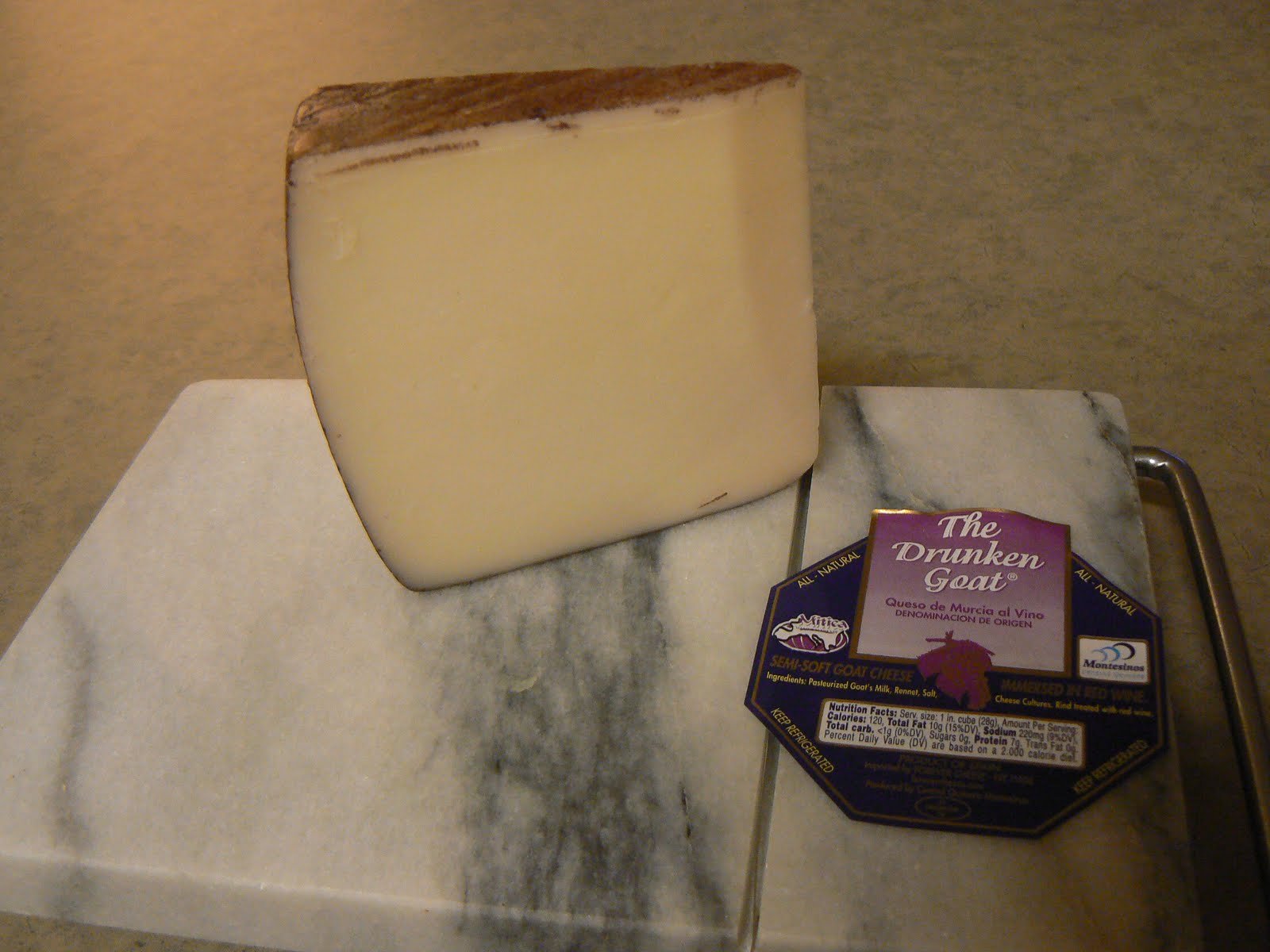
We begin with a selection that the casual goat cheese enthusiast will likely recognize and which is at home on any cheese plate: The Drunken Goat. Hailing from the town of Jumilla in the Murcia region of Spain, this is effectively the gateway drug into the world of wine-bathed cheese.
Origin: Murcia, Spain
Milk: Goat, pasteurized
Rennet: Animal enzyme
Affinage: 75 days
Notes: Soaked in Doble Pasta red wine for 48-72 hours. The cheese, that is. The goat just had a glass. This cheese is also name-protected under Spanish law.
Thoughts: The bone-white, semi-firm paste that is so characteristic of aged goat cheeses is enticing enough, but just upon unwrapping this treat it becomes clear that the vino-bath paid off. The aroma, while not overwhelming, is pronounced and, combined with the purple/brownish coloring that covers the rind and seeps ever so faintly into the paste, will make you start to wonder what else could be improved with 3 days curing in wine. Truth be told the cheese itself is a fairly average, if respectable, example of slightly aged goat cheese. The flavor remains mild from start to finish and the usually pronounced "tang"of the goat's milk is hardly noticeable at all. The texture is well balanced and creamy enough to somewhat make up for the understated flavor but I would trade a drier texture for a sharper flavor. The natural sweetness of the goat's milk does, however, compliment the sweet and fruity tones imparted by the wine bath, leaving you with a cheese that serves as a wonderful introduction to the subgroup of "drunken" cheeses. There are others, such as Irish porter and whiskey cheddars and Italian Ubriacos, but these tend to sour the less adventurous sampler with their intensity. Don't dismay, they're coming.

Drunken Goat gets seven arbitrary units of measurement out of ten, but this next cheese needs no introduction. Rather it deserves no introduction.
Landana Mild Goat
Origin: Netherlands
Milk: Goat, pasteurized
Rennet: Think the drummer from the Muppets
Affinage: 6-8 Weeks
Notes: Unmistakably cheese.
Yessir.
Thoughts: The sad truth is that there just isn't a whole lot to say about this cheese. I recall it was one of the first cheeses I recorded and photographed, distinguished by my short-lived habit of photographing the label along with the cheese, and I remember being generally disappointed to then find myself with sizable block of forgettable cheese. This was back when I was a cheese fiend sans employment, and when the checks aren't coming you can't afford to throw money away on sub-par Käse. The flavor is beyond mild, the only marginally noticeable characteristic being a hint of sweetness. The texture and creaminess would be suitable if there was any flavor to discern, but this the celery of goat cheeses, you'd die of boredom before it filled you up. My advice? Either find some bread and jelly or skip the middleman and just eat the peanut butter off the spoon. Maybe that's a bit harsh, and if you happen to find the black wax label 10 month aged Landana Goat Old do let me know what you think, but there just aren't any redeeming qualities to this cheese. There are lessons to be learned from this:
1) Not all that is imported is made of gold, the Europeans get it wrong too, and
2) Young goat Gouda is no better than young cow Gouda, they both belong on sandwiches not serving platters.

Don't worry, today's third cheese is a standalone rockstar and more than makes up for Landana's lack of character and flavor, but first some more news. The astute Sherlock Holmesian (Dr. Houseian?) reader will notice a new addition on the sidebar; some difficult to read and overly flowery text (I really must fire the intern responsible for all these run-on sentences of late). Directly below that paragraph there is a link to what may be simultaneously the most laughable and most telling sign of my addiction: my quick-reference cheese chart. Once upon a time I was a student of engineering, a well informed decision I made based on 18 years of enjoying playing with Lego, not hating math classes and a dream of one day earning money.  That story ended in tears (I realized I'd rather work with travel and politics than numbers and dirt) but i maintained my tendencies of over-analyzing and over-organizing.

The result is the cheese chart, containing the basic traits of all the cheeses I could find, as best as I could find them. I will admit not every box is checked, but in general the important information is there. A note on pasteurization and rennet type: if you are unsure about either and are greatly concerned, find a cheese you can be certain about. That being said cheese that is not labeled in any way as being microbial or vegetarian friendly can be safely assumed to use animal rennet; it is a big enough selling point that most manufacturers will want to make their animal-friendly ways known. As for pasteurization, international cheeses that do not specify "raw milk" "rohmilch" au lait cru" or "leche sin/no pasteurizar"will typically be be pasteurized, especially considering the legal difficulties with importing raw dairy products. As for domestic cheese, the vast majority will be pasteurized, thanks again to the tastebud-impared folks at the USFDA. Those that aren't will be marked but again, although I personally think the only real danger of eating unpasteurized cheese is having your mind blown in a flavor explosion, if you are seriously concerned then stick to the pasteurized stuff. Pasteurization deserves its own post and will get it soon. 
In any case I hope this resources is in some way helpful to those looking for a fresh French goat cheese or an unpasteurized cheddar or what have you, and of course I am always eager to answer cheese queries and help with pairings, platters ideas, and other manifestations of my addiction. The email address in my profile. PS: if you like the blog so much that you want to know when it's updated feel free to "follow" The Functioning Cheese Addict and make your addiction public as well. That link is also hiding on the left. 


Now for the main attraction, the Titan of Tuber Tastiness, the Giant of Goaty Goodness, here all the way from Cypress Grove Chevre in California; Truffle Tremor. Cypress Grove represents what is  truly the pinnacle of domestic goat cheese production, accept no substitutes. Their lineup is consistently incredible and varies from delicate fresh chevre to perfectly surface ripened gems to the best goat Gouda I have yet tried. Truffle Tremor is one of their more adventurous products but if decadent is what you're after then look no further.  
Origin: California, USA
Milk: Goat, pasteurized
Rennet: Full-fledged, no chicken no fish vegetarian.
Affinage: Up to one month
Notes: This particular specimen is on the older side of the surface-ripened cheese hill, as seen in the size of the creamline (or proteolysis), that bit bit between the soft white rind and the paste. Furthermore this cheese is made with black truffles, or tuber aestivum vittadini. Science Rules!
Thoughts: First of all, if that picture is not enough to encourage you to go out and purchase a wedge right away, well there may just be nothing more I can do for you. Even this rather aged variety maintains a soft and fluffy rind, yes this is one of those rinds you should definitely eat, while also showing how the proteolysis is slowly consuming the bone-white paste. Cheese is alive, true story. That process is the cheese naturally aging, as surface-ripened cheeses are apt to do, up until the point that you eat them, offering a lot of control over how sharp, creamy, and acidic you want your cheese experience to be. Truffle Tremor is a delight at any stage, but in this more mature state it truly defines the word decadent. The paste of the cheese is sharp and very rich, taking full advantage of the creamy goat's milk but maintaining a clean feel. Savory without being the least bit earthy, it combines with the milky creamline and the extra kick from the rind to create a flavor that is complex but not muddled. Throughout all of this is the steady umami kick of the truffles is present and adds yet another dimension of flavor, one distinct but so refined that it almost gets lost in the mix, preferring to remain relatively in the background from start to finish. This cheese is the first to go at parties, it is the favorite, it is All-Star Quarterback Johnny Footballplayer, it is Ms. Overachieving Social Butterfly/Homecoming Queen/Yearbook Editor-in-Chief. Buy a wedge, leave it wrapped up but unrefrigerated for about a half an hour on your kitchen counter, cancel your evening plans, and get your baguette on. 


Caution
The USFDA recommends that pregnant and nursing women and anyone with a weakened immune system avoids unpasteurized milk and dairy products. Your health is ultimately more important than trying every cheese out there, and there are lots of good pasteurized cheeses to be had. 
On the other hand, the US Government also recommends avoiding travel to Bosnia, Kosovo, Albania, Serbia, China, and the Caucasus. Really only one way to find out what all the fuss is about.
Just Sayin'