Showing posts with label Cow. Show all posts

Tuesday, June 4, 2019

Shropshire Blue, or Blue Stuart, or Inverness-Shire Blue, or, or, or


How about that? How about that classy-as-all-whatnow photo. You got your flower pottery. You got your baguette in the blurry background. It's like we're siting in a tuscan village or something. Except the bowl is from Poland. And the baguette was baked here in Munich. Also the cheese is English. Well.

So there you are sitting at your EU Summit table in Brussels, debating the terms of the exit of the UK or the entry of Turkey, and what is this magical food stuff before you? Is it a blue cheese? It certainly looks that way. Is it a cheddar? Well.... it is yellow. It is, of course, Shropshire Blue! Always known as Blue Stuart. Aka Inverness-Shire Blue. Feat. Flavor-Flavor.

Origin: Leicstershire, England
Milk: Cow, pasteurized
Affinage:  3-4mo

Notes: Vegetarian rennet! Juhu! Vegetarians rejoice.

Thoughts: Whoo-boy. This. This is a blue cheese. Don't let the yellow fool you. If you close your eyes, all you will taste is Stilton. This particular example has been aged long enough for the veining to riddle its way right through the paste, taking no prisoners. Long since gone and forgotten are the savory and sweet notes of the original cheese, all that remains is minerality and fire and pepper. It's a dry cheese, like the desert is a dry heat. It's a lovely cheese, and one that always has a place on our English Cheese boards.


If and when things do go south with this whole 'will they/won't they' Brexit dramedy, we all know that the real victims will be the cheese producers and cheese lovers. Stock up now. 

Tuesday, May 28, 2019

Val d'Armance, or The Thunderdome!


What do you do when your favorite cheese store is out of your desired curd? These are the moments, ladies and gents. The real nitty gritty, where the rubber meets the road, where the men are separated from the mice, where the toppings meet the pizza, where the wheat and the chaff meet at a fork in the road and before you know it you turn around and there's three more rabbits in the the pen then there were this morning. And are you ready to handle that!!?! I didn't think so.

This is the Thunderdome.
This is The Avengers in getting all avengery in whatever movie comes out in 2065 or whatever.
This is Snake Plissken escaping from NYC. Or LA. Or something.
This is
This is....
This is a pretty rough situation!

This is also why you want to have a top notch guy as a cheesemonger. When you say 'hey, where is the delicious young Époisses I had the other week' and he says 'we're all out' and you say 'aw man!!!' then he can say 'don't worry though we've got you covered try this instead it's similar and fantastic.' And that. That is how we get to Val d'Armance.

Origin: Champagne, France
Milk: Cow
Affinage: 3-4 weeks


Notes:  This one was a fairly young example, not yet fully eaten up into creamline and funk. Now, I'm not against funk. I can get down on some funk. But to get all the layers of flavor and complexity that is hidden there, it helps to have a cheese that doesn't already resemble soup.


Thoughts: Looks so funky, tastes so sweet. Butter-sweet. How does this taste so sweet? How does a washed rind cheese get away with tasting so sweet? Don't get me wrong, there are other things going on here as well. Mushrooms and garlic, our old friends, are at it again playing their familiar duet, but the guy with the megaphone in the room is Mr. Sweet. This tastes like how late spring days feel. This tastes like how loamy earth smells. There are even notes of black pepper that bounce off the buttery sweetness! The rind has a delightful texture and melts in your mouth, what more could you want?!


Escape from Detroit? Escape from Bloomington, IN? Escape from Montpelier, VT? 

Tuesday, May 21, 2019

Beaufort Été, Summer '17, or 'Easter Cheese'


OK, so in a recent post I may have spoken poorly of the style of cheese known as Bergkäse. Just like with most any other non name-controlled cheeses, there's a few gems out there and a lot of lemons. Or, like, ducks. End-tables? Whatever the accepted stand-in term is for something that is not good in the greater category of cheese.

Today, though, we are not dealing in ducks. We are dealing in high grade curd. AAA. Top Shelf. Handcrafted. Seasonal. Holiday themed.

Wait.
Holiday themed?

Yes, dear reader, you read that right. We have here an Easter special! More specifically, today we have a Beaufort Été from the summer of 2017, cared for and watched over just to be ready for Easter 2019. This is, in any case, what my local cheesemonger said. Sounds good! How does it taste?


Origin: Savoie, France
Milk: Cow, raw
Affinage:  ~20mo


Notes: As everyone knows, there are three different kinds of Beaufort: Normal, Summer, and d'Alpage. This is the Summer variety, so the milking was only from the summer pastures between June 1st and October 31st in 2017. That sweet sweet summer grass, those fresh herbs and flowers? You had better believe they'll show up in the cheese.

Thoughts:  The smallest piece of this is a smack in the face of flavor. Truly every crumble of this packs a whole meal's worth of complexity. Starts off surprisingly sweet, grassy sweet like your favorite cheddar, but the longer you enjoy it the more layers reveal themselves. As the cheese breaks down on the palate it quickly becomes hauntingly dark, with hints of garlic shoots and raw notes playing off each other, the end of the flavor even teasingly toasted. The texture is perfect, full fat and the odd crunch here and there. This is as near as I know to a perfect cheese. This is art that you can eat. This is luxury, decadence, the absolute height of cheese indulgence, such that it seems a bargain at eur 4.80 for 100g. For the price of one gross Starbucks coffee drink, you can be transported through your tastebuds to a high meadow in the French alps. In Summer.


Coasters? It's a spare tires? Shirt collars? I don't know much about this, but I feel like calling an automobile a fruit is one thing but calling a food a food is just crazy. Clearly a cheese cannot be a fruit. That's absurd. 


Tuesday, May 14, 2019

Wiesenblumenkäse, or More German in These Titles!


If you are like me, you love cheese. If you are like me in additional ways, you also have a fairly skeptical eye when it comes to new cheeses. After a #blessed life of Taleggios, Comtés, Quadrello di Buffalos, Stiltons, Brie de Meaux, Cabra Romero, Montenebro, Farmhouse Cheddars, and, and… well I mean can it really get better? Is there better cheese out there? Forget better, is there other cheese out there that is still worth taking a financial risk on? What if it’s bad? Or, well, just forgettable? 

The world is on fire, and these are my concerns. 

I’ve ranted here before about how cheese + (alien substance x) generally gets the hard end of my judging judgment, as a truly great cheese would be able to stand by itself without adornment of bunches of black truffle, or seasonings thrown on top, etc etc. But! There are exceptions to this rule, and a good thing too. Otherwise we would not have the wonderful treat that is Wiesenblumenkäse, or the other Blumenkäse of its ilk. Yes, there is a whole ilk of this stuff. Wiese means field, Blume means flower, and Käse means cheese. I truly love the German language. 

In another rant, on another day, I’ll have to drop a little German language knowledge, and see how long and funny of a cheese name we can come up with. 


Origin: Switzerland? Thiesen?
Milk: Cow
Affinage: 6-8 months


Notes:
There are really just dried flower petals pressed all over the rind. Not rotten, but dried. There are very sporadic and small holes in the paste and tiny calcium crystals, so there is a lot going on here. 


Thoughts: 
Butterfat is the first thing you notice, as it immediately washes the palate in a rich wave of creamy goodness. For a ‘schnittkäse’, it is really very soft and bursts with floral flavors, that very butterfat being the perfect solution to draw out the floral notes. Not sweet like some fatty cheeses, it is savory with a full mouth feel. Herbal, with an aftertaste of onions and chives. Every now and then you get a bite of a piece of dried flower petal that has fallen from the rind, adding texture and a reminder of the flower petals from which the cheese gets its name. It does not have the gooey texture and salty pungency of other savory delights like Taleggio, but still delivers a complex experience that demands your full attention. Keep a bit of apple or wine on hand, because you will want something to cut through the fat in order to enjoy the third bite as much as you do the first. That being said, your breath may smell richly like cheese after this one. Like dried flowers and dried milk and more curdled and cut and aged milk.


Schnittkäse is one of a number of German language terms for cheese that do not translate directly into the English I grew up with. Cutting cheese? Cheese that can be sliced? Semi-firm cheese that lends itself well to slicing? There is a similar question about as to what Bergkäse means. What is and what is not a Bergkäse. Then again... myself and others grew up with the phrase 'Swiss Cheese', which is about as airtight a designator as... well... as Swiss cheese? 


Tuesday, April 30, 2019

Le Petit Fuxéen, or How do you Say That?


Seriously, I think it is fair to say I chose the wrong language to learn if I wanted to sound real clever and convincing while talking about cheeses. I mean, the newcomer to the blog could be forgiven for thinking I only write about cheeses with German names, but I do in fact love French cheeses as well! It just so happens that knowing German, a phonetic language where every letter is pronounced, does one little good when trying to pronounce French cheese names where... seriously what am I supposed to pronounce again? I can do pretty well with 'le petit'. Maybe I need to do another exchange year, just work in a cheese store in Strasbourg or, I don't know, Toulouse? I hear it's alright there.

Origin: France
Milk: Cow, raw
Affinage: 45 days

Notes: What I want to know is, where are the gran versions of all of these petit cheeses? OK, seriously. It is a washed rind cheese from the Pyrenees region of France, although it does not smell nearly as, ehm, voluminous as some washed rind cheeses. Quite the contrary. Pretty rind though!

Thoughts: Hints of cream and garlic make up a very mild cheese, much milder than it looks and even milder than it smells. As with so many washed rind cheeses the bark is worse than the bite. The rind is perhaps the only caveat there, as it is quite thick and gritty for such a thin cheese. Get a rind-heavy bite of le petit Fuxéen and you will be quickly reminded of the style of cheese you are indulging in. The smoothy mouthfeel of the paste is the dominant expression in the cheese, carrying the flavor notes along in a pleasant but not overwhelming wave of cream.


Anyone know a French tutor that accepts payment in cheese? Or, say, mildly cheese related musings? 


Tuesday, April 23, 2019

Époisses de Bourgogne, or 'Holy Moses, kid!'


Sometimes, living in Germany, I start to get complacent. I mean, if you based your view of the cheese world on typically Swiss, Austrian, and German cheeses (typically what is on deep sale at my local stand), then you would be forgiven for thinking that all cheese is firm, made from cow's milk, and ranging in flavor from mildly buttery to sweet and nutty to, on occasion, sharp. I don't mean to insult the culinary credentials of my current country of residence, I am learning every week to appreciate the cheeses of the alps more and more. But, if the whole world of cheese flavors is a cathedral organ, then limiting yourself to eating only the cheeses from three countries is playing on only half an octave.

Sometimes, sometimes you have to remind yourself of the depth and breadth of what mankind can do with a little milk, a bit of patience, and a lot of skill. France is never a bad place to start. To that end we are tackling a legend of the French cheese scene, a cheese so renowned that it is actually embarrassing to not already have a post for it here on the blog: Époisses de Bourgogne.

Origin: Côte-d'Or, France
Milk: Cow, raw
Affinage: 4 weeks

Notes: Washed rind, brandy washed rind to be exact. What style, what class. This was a young one, still with a defined and firm white paste.

Thoughts: Hot dog. This is good. How good? As my grandma used to say "Holy Moses, kid!" We're talking mushrooms. We're talking roasted garlic. We're talking black pepper. This particular example was also sweet, and creamy, with a firm and defined paste that holds its own against all of the pep and power of creamline and rind. This is a balanced and delicious cheese, every bite a piece of culinary delight. Every element of this cheese, paste, creamline, and rind, come together in distinctly delicious ways to create a symphony of flavor. It is in balance, it is elegant.  This cheese deserves epic poems and entire 5 course meals based on it.


New challenge for next dinner party: Five-course Epoisses inspired menu. 

Tuesday, April 16, 2019

Stafelalper, oder der aus Zermatt


Yes, this is again a cheese I've purchased from the sale section (sale board, really) of my local cheese stand. I can't keep myself away. It's lovingly scripted invitations to try one of five or six (usually German, Swiss, or Austrian) cheeses is a siren song under whose spell I am powerless. Not all of these cheeses are winners. Some are labeled 'mild', which translates from the German roughly into: lacking a strong or powerful flavor, making only a little impression, see: bland. Others, however, carry the honorific of 'würzig'. I want würzig. And I will have würzig. And today I am going to write to you about würzig.


Origin: Zermatt, Switzerland
Milk: Cow, raw
Affinage: 14 months

Notes:
Würzig doesn't have a perfect translation into English, but comes pretty close at 'flavorful'.  Flavorful+. Flavorful + Spicy, but not like chili peppers spicy rather spicy like there are spices afoot here. Maybe just flavorful. If my armchair linguistics serve me correctly, it is related to the German word for spices; Gewürze. Which is a little misleading, considering this cheese has only milk, rennet, and salt* as ingredients.

Thoughts: This cheese has a lot going on! And I love it all. The initial impression is like biting into a well aged cheddar, all crunchy-chewy and creamy-sweet paste. Right away it takes a sharp left turn, though, and establishes itself proudly as a Bergkäse. The raw milk doesn’t bludgen the tongue and gums the way some are known to, but adds simply another pleasing layer of flavor and complexity. It is grassy and peppery on the front, but as the butterfat breaks down on the palate who is that over there all of a sudden?! Pears and berries! In a Bergkäse. What will they think of next! Everything on this cheese is working in symphony to create a real class act of a Bergkäse. The delicate crunch, the buttery paste, the raw milk and the peppery, fruity aftertaste. Next time you’re in Zermatt, make sure you track it down!


*Yes. Yes. I know 'salt' is a spice. In the way that water is a beverage. 

Tuesday, March 19, 2019

Gewitterkäs, or LIGHTNING CHEESE (!!!!!)


Today’s cheese has a different name depending on what country and language you happen to be buying it in. The cheese itself, that is to say the label in the home country of Switzerland, says Gwitterchäs. This is of course Swiss German for Lightning Cheese. Swiss German, in German, is called Schweizerdeutsch. In Schweitzerdeutsch, though, you don’t say Schweitzerdeutsch, you say Schwizerdütsch or Schwiizertüüsch, and you don’t say Gewitterkäse you say Gwitterchäs. That is, if you’re speaking Schweitzerdeutsch/Schwitzerdütsch. If you’re speaking Deutsch which is to say German than you say Gewitterkäse unless you’re speaking a local dialect in which case it might be more like Gwitterkäse or Gewitterkäs or Gwitterkas. Really it’s a wonder this cheese ever made it all the way over to my local cheese stand in Munich. München. Minga. 


Origin: Toggenburg, Schweiz
Milk: Cow, heated but not pasteurized
Affinage: 5 months

Notes:
Made, as the story goes, when a lightening storm hit the dairy and the recipe for a different cheese was mistakenly altered, resulting in this very buttery ‘mistake’. 

Thoughts:
Smells sweet like caramel or buttered toast. There is an earthy wildness to it, with notes of garlic and a texture that melts in your mouth. The more you eat the stronger there develops a theme of green onions, all carried along on a wave of heavy cream. The aftertaste has the raw milk tang we all know and love. It tastes fresh and vibrant, something you want to eat with a hearty beer. A slight peppery bite now and then due to the raw milk. 


You know what they say: 'Washed rind best rind'. 
They're always saying that.  

Tuesday, March 5, 2019

Grantrento, or the other other grating cheese


Quick! List off for me all of the grating cheeses that you know!

.
.
.
.
.
.
If you said ‘parmesan’…. I’m not mad I’m just disappointed. 
If you said 'gouda'... ... ... I actually am mad. Also disappointed. 
If you said ‘Parmigiano Reggiano’, ‘Grana Padano’, or ‘Pecorino Romano’, then you probably like a little bit of pasta with your cheese.
.
.
Others? 
.
.
Yes, apart from some brave newcomers these three have classically had a pretty handy corner on the market. I didn’t even know to look for today’s cheese, Grantrento, in fact we stumbled upon it when we popped into a dairy on our last trip to Italy. Nestled in the Val de Non in the mountains of northern Italy, surrounded by dramatic canyons, vineyards and apple orchards, one finds this little gem. Grantrento. Looks like a grating cheese. Smells like a grating cheese. Made like a grating cheese. But can it hold its own??


Origin: Trentino, Italy
Rennet: animal
Milk: Cow, unpasteurized
Affinage: 12 months or more

Notes:
This would to me be an argument for always going into every local dairy you come by and just having a go at whatever they’re selling. 

Thoughts:
In comparison to your more well known King of Cheese, Grantento is rather more peppery and less salty. A charming crunch and well balanced fattiness makes this a winner by itself or as a garnish. Towards the end you get notes of baked mushrooms and the raw milk tang is pleasantly present in every bite. It is not a replacement for King Parm, but after eating it on pasta and cheese boards for a few months in different constellations I would happily stock it in the Functioning Cheese Refrigerator. If only because it meant I got to keep on visiting Italy to buy more! 


Not a bad place to grow apples and make cheese! So many apples. Much more apple than cheese. That's why the valley is known as the Big Apple.  Land of 1000 Valleys. Valley of 1000 Lands. 


Tuesday, February 26, 2019

Abbaye de Tamié, or The Good Life


What does the good life mean to you? As any good student of political philosophy will tell you, the very definition of the ‘good life’ is such a bedevilling concept that it fouls most any attempts to create a universally acceptable form of government, what with so many different understandings of the phrase going around.

These Trappist monk guys, though, they have got a clear idea of the good life. Worship, serve, and know God. Make delicious cheese. Surely something more, but at least those two basic steps. If it weren’t for my very much decided dedication to this whole marriage thing, I’d say that sounds like a real winner of a life plan! I mean, some Trappists even throw in making the best beer. in. the. world*. What a daily routine! 

Origin: Savoie, France
Milk: Cow, unpasteurized
Affinage: 4-8 weeks

Notes:
Favorite cheese for people who like to say “heeyyyabooooooott!!”

Thoughts:
The tang and funk of the raw milk hits you on the front end, but all in all a mild and unassuming cheese befitting the style. It has a clean and neutral aftertaste, like water that has run over mountain grasses. This is a creamy textured cheese, but airy and light. Similar mouth feel to Taleggio, without the punch. Smells nutty, and slightly of hay. Very light notes of wild garlic. 


*Send all hate mail to keepyourtrashIPAs@hipster.barf 

Tuesday, February 19, 2019

Voralberger Kristallkäse, or The Stink King of Austria


Dear reader,
Usually I’d say avoid products sold to you by the gram and beginning with the word “kristal..”. If you have a trustworthy cheese guy, though, and it’s on sale… I mean… if it’s on sale. For today’s post I take the plunge and you can read from the safety of your couch. Or wherever you’re reading this from. Bathroom, probably. 

Origin: Bregenzer Wald, Voralberg, Austira
Rennet: ?
Milk: cow… raw?!
Affinage: 12 months

Notes: 
Who has time for notes?! Lets do this!

Thoughts:
New York’s hottest club is SPICY!!!!! 
The first bite hits the nose hairs like a fireball. This is sharp, harsh, and aggressive. I get a lot of garlic, hot and firey like eating raw garlic. The front end is like hitting the sweet spot on an aged cheddar, but then it all builds and overpowers you. The flavor lingers all down the back of your throat. Buttefat blends into garlic, which then just stays. This will get into your pores, and it stays like an unwelcome guest. The odd calcium crystal is a treat, but the texture is generally totally overshadowed by the flavor. Could be substituted for smelling salts for bringing the dead back to life. This is a rare cheese, in that I had a hard time finishing it. The second and third bite were just the same, the second day of eating it just the same. This is seriously the funkiest and stinkiest cheese I’ve had since… since Gamalost. It may not take that crown (perhaps nothing ever will) but this is a contender. 


This cheese easily makes the top 5 stinkiest list. Be ready for your whole refrigerator to smell like this cheese and nothing else. Stinky cheese lovers rejoice! 

Tuesday, February 12, 2019

Ricotta Fresca de Parma, San Salvatore, or The Dirtbag Grand Tour Pt. 2


Ricotta. How is it that the world is not just raving about ricotta? I mean, if you were to believe the news, avocados are effectively the only thing that ‘irresponsible’ millennials are allowed to spread on toast, cover with salt and balsamic vinegar, and crush into their mouths to drown out their sorrow at the economy, political system, and environment having been left in ruins by previous generations.

But the news is wrong! There’s also ricotta. And ricotta toast. And it's one of my favorite cheeses/meals. It doesn’t do much to stop the privatization and degradation of irreplaceable public lands, it doesn’t help in the fight to ‘throw the bums out’ and restore credibility to a representative democracy, and it doesn’t look likely to bring the average wage into sync with this decade(century)…. oh guys. But it tastes good.

I’m not advocating for gastronomic escapism. Maybe I just need a little lift today in light of the realization that all the relative stability we take for granted is in fact an incredibly fragile and delicate dance that, if history is to be relied on even a little, will surely collapse under the fatigue and strain, and that this will likely happen in our lifetimes. I don’t mean to cry wolf here on this forum usually dedicated to the pure pursuit of the ultimate curd, I just wonder if the Viennese born into the twilight of the 19th century ever thought things could ever fall apart so badly so quickly. 

Origin: Parma, Italy
Rennet: Animal
Milk: Cow
Affinage: fresh!!!


Notes: 
I’ll try to stay on topic here. Ricotta is, of course, not a cheese at all. Much in the way that Geitost ist a tricky and delicious repurposing of whey, the main byproduct of cheesemaking, Ricotta is actually a result of a further heating and handling of whey. This is great news for us, as it is generally well priced and almost universally delicious and adaptable. Even your supermarket brand will be good in recipes or dressed up with toppings, but a few special producers make a product so clean, so pure you will want to eat this right from the container. Today’s example is one such product. We picked this little number up at the Caseificio Sociale S. Salvatore when we stopped by for the Parmigiano Reggiano I wrote of recently. We had been sleeping in tents and cooking our meals over camp stoves for a few days at that point, just soaking in the absolute beauty of northern Italy's lakes. Our friends are masters of the camp stove gourmet meal, but we all agreed the short pit stop we made eating this container of Ricotta was a highlight meal of the trip. We bought it more as an afterthought after getting our requisite half kilo of 3 year Parm. I won’t torture you by telling you how little all this cost when buying it from the actual guy who stirs the milk vats…. but let’s just say the economics make a man start considering the costs of annual plane tickets compared to the relative savings on supermarket prices. But Ricotta! Best impulse buy of my life. I mean, if you are working with the same cows that make the milk for Parmigiano Reggiano… well would you want to let one drop of that white gold go to waste? Me neither. 


Thoughts:
Do you know those nature programs, where you see a snowy hillside and on that hillside there is actually a snowshoe hare or a snowy owl? This cheese tastes as fresh and as light as that new snow, quiet and smooth. It is rich. It is silky. It is everything Ricotta fresca should be, a delicate but indulgent bite that works as well savory with tomato and balsamic as it does sweet with honey or jam. The velvety texture begs to be heaped generously on bread or crackers and gives a mouthfeel that deserves its own blog post. Never has so little money purchased so much luxury. 


Seriously. #RicottaToastRevolution. 
On an unrelated note, avocados in Germany are 1) absurdly expensive and b) usually awful. Didn't know avocados could be awful? Neither did I. But I hate it. You know what doesn't let me down here? You guessed it: ricotta.  

Tuesday, January 29, 2019

Gołka, or Finally A Cheese In the Shape of a Barrel!


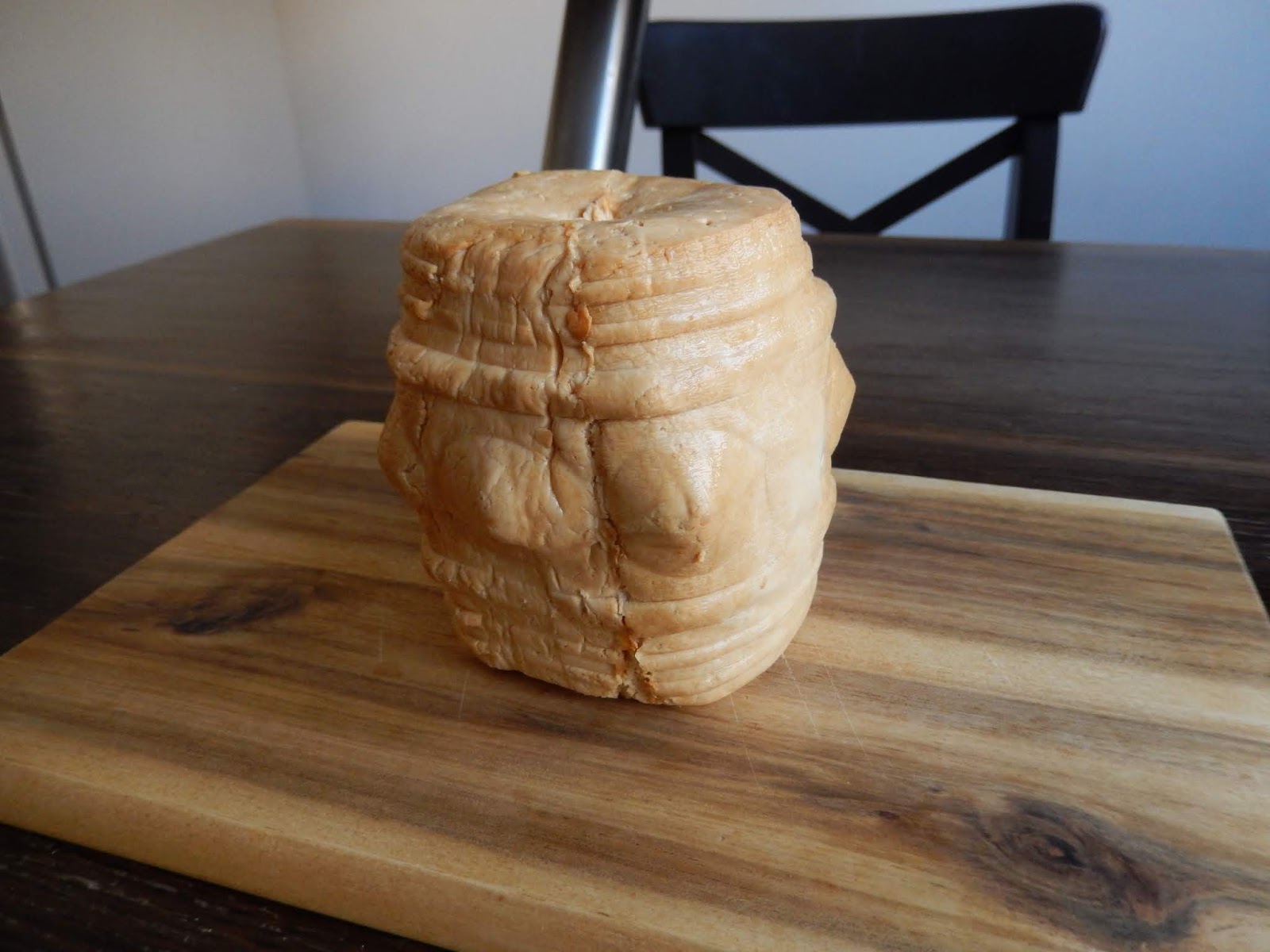
Sometimes you have to look far and wide to find your next cheese. As far as the local farmers market and as wide as will fit in your fridge. Sometimes the cheese comes to find you! That is the story of today's cheese; Gołka! Two brave travelers brought these Polish cheeses back from a recent holiday and, after initially being intimidated by the spiky-barrel shape right out of a Mario game, I finally dove in. Now, I freely admit that I don't speak or read a word of Polish, which made deciphering the label somewhat of a puzzle. Fortunately, as the old saying goes, I've been to the rodeo before, and this is my kind of puzzle. I employed every trick up my sleeve and determined that this is, indeed, a cheese. We were given one plain and one smoked, both fairly identical looking except for the coloration.

Origin: Poland
Milk: Cow, pasteurized? Conflicting Reports
Affinage: 2-3 months

Notes:
There is a sheep milk version of this cheese that I'm now itching to get my hands on. I guess both this and the cow versions that I tasted are typically holiday cheeses, name controlled even, and as a result only really to be had at certain times of the year. Also the curd is salted! Which, I mean, may go a ways to explain the flavor. Also some sources say this cheese is a raw milk cheese... but I believe my label said pasteurized? Hard to say.

Thoughts:
Plain:
Slightly squeaky and tart like a cheese curd. It is a primarily salty cheese, but develops as the fats break down to a grassy sweetness, like a raw cheddar. The beginning is a neutral milky flavor, but builds ever more as you chew until at the end notes of meat and onions pop up. Doesn’t taste like health food, rather it is heavy and savory and rich. Definitely tastes tart and wild like a raw milk cheese, but that label? My vote is on raw.

Smoky:
The smoky aroma wafts over the palate as you bite into it, and really presents throughout the entire bite. Just as salty than its unsmoked relative, but more balanced due to thesmoked treatment. The smoke is not that gasoline-awful-artifical flavor, but rather a complex and constantly evolving addition to the cheese. The texture of the smoked rind is also a nice variation from the otherwise one-dimensional paste. Make no mistake, this is also a hearty and meaty bite. It wants a crisp beer like cats want to knock things off tables.


Possibly the first Polish cheese on the blog? Very possibly. I'd buy (or be gifted) it again in a heartbeat though! That sheep cheese also sounds really good, and just the other day I was alerted to a whole range of balkan cheeses. Auspicious times are ahead for this Functioning Cheese Addict! 


Tuesday, January 22, 2019

Obatzda, or Frischkäsezubereitung


Ja Hallo, einen schönen Guten Tag wünsche ich euch alle, liebe Leser. 
Heute bringe ich euch was sehr besonders, eine Frischkäsezubereitung aus unsere aktuelle Zuhause; Bayern! 

Ja, Bayern: wo die Kühe freundlich sind und der Käse herzhaft. 

Wie alle gute Deutschsprecher(leser) wissen, Obatzda gehört genauso viel zum Biergartenkultur wie... also, Bier. Und Gärten. Eine absolute Schatz an das Leben hier in Bayern ist, dass viele Nachbarläden ihre eigene Rezept dafür haben und dir auch frische Brezen dazu verkaufen wird. Also gönn dir! 


Origin: Bayern, Germany
Rennet: Animal
Milk: cow
Affinage: n/a

Notes: Comes in a tub. Orange. Orange with white splotches and other rando pieces of stuff in there, to be more precise. Smells pretty strong. Did I mention it gets spatula-ed into a plastic tub? Eaten traditionally with pretzels or good brown German bread. Home-made all over, your mileage may vary. 

Thoughts: Wowzers. It’s not every cheese you smell increasingly strongly before you take your first bite This one is powerful, though. If it were an animal in the wild, it’d have big colorful stripes or badges to ward off predators. Or, you know, some sort of pheromone producing gland.  Eaten alone (for sciences’ sake), it is overwhelming. Creamy, spicy (but not hot), a little warming in the aftertaste, almost a blue-cheese like funk, and that familiar sensation when you know you are now in 100% cheese breath mode. Usually this takes a lot of cheese eating, but with Obatzda, one bite is all you need. Now for some more orthodox tasting, spread on a pretzel. OK, so let’s talk about salt. Now, pretzels can have a lot of salt on them, sometimes you may be asked by your local baker if you want a normal or lightly salted pretzel, I’d put these today firmly in the 6/10 in their saltiness. This is important because salt also happens to be one of the few ingredients of cheese after milk. This particular ‘cheese’ also has some paprika and other spices added to it, so…. this is a very salty bite is what I’m trying to say. Those of you who know and love Germany will not be surprised by this. It is 100% normal here to bring a hardboiled egg as a snack with you on a hike, but only if you also bring a tiny single serving package of salt for to salt said egg after you’ve shelled it (Do you ‘shell an egg’? Peel an egg? Release an egg?). I digress. Obatzda! Dang this stuff is delicious. It is actually very very sweet and creamy, which acts as the perfect vehicle for the paprika and onion and, well, salt, providing a great contrast and basically making you want more and more. Salt and fat. Salt and fat. Garlic is in there, onions poke up here and there, but really this is classic bar food. Bavarian style. I love it. Cheese breath forever!!!


i bim bloß a gloana Kasbuam! 

Tuesday, January 15, 2019

Three Year Parmigiano Reggiano, Caseificio Sociale San Salvatore, or The Dirtbag Grand Tour pt. 1


Have you ever had baked beans in Boston? How about deep dish pizza in Chicago? Have you ever longed to try sourdough bread in San Fransisco or the midwest’s most confusing submission to the US national cuisine, Cincinnati Chili, in Cincinnati? That is admittedly a very US-centric list. Eh… how about a single malt on the Isle of Skye? Lángos in Hungary? Kürtőskalács in… Hungary? Feta in…. I feel like there is no good way to continue this train of thought without offending entire countries.

What I’m trying to say is that today we’re sticking to the hottest new diet craze ever to come out of an obscure and sparsely updated cheese blog: The Do The Thing In The Place Diet. Trademark The Functioning Cheese Addict. (Thats how you register trademarks, right? I declare a trademark!). I swear there’s something about cheese here somewhere. Parma! Today, and despite all evidence to the contrary, I’m writing about Parma. The city, the legend, the birthplace of (food) kings.

Years ago, when the world was young and the US had a fully funded government, I traveled to Parma with my wife and best friends as part of a camping and cheese tasting trip through northern Italy. Like a dirtbag-y Grand Tour that constantly smelled like cheese. All we were missing was a DIY converted camper-van. It was without exception breathtakingly beautiful, and I’ll have to mention the valley of Taleggio sometime later, but today prize of place goes to Parma and the King of Cheeses: Parmigiano Reggiano.

We traveled miles and miles south of the alps, across the Po River valley, and very nearly were thwarted by a downed bridge, but just when we were near to giving up we stumbled upon Caseificio Soziale San Salvatore. We were late arriving and walked in just minutes before the riposo began, but the staff were legends and not only sold us their wares but also gave us a tour. A tour of their beautiful beautiful aging room. A tour of the (already finished for the day) vats. A tour of the brining room. We walked past and gawked at a small fortune’s worth of Parm, and as the photos give evidence I was completely overwhelmed. I speak, of course, effectively no Italian, but as it so happens having 100% of your vocabulary in a language be cheese related makes you fairly well situated to talk to a cheesemaker. We purchased a three year reserve Parmigiano Reggiano and a tub of Ricotta Fresca, thanked the man profusely, and retired to a nearby park to descend upon our bounty.

That is the story. Here is the cheese.


Origin: Parma, Italy
Rennet: Animal
Milk: Cow, unpasteurized 
Affinage: 3 Years! Woop Woop!


Notes: 3 Years of aging technically makes this a ‘Stravecchio’ example of its kind, but here’s the real hot tip: They definitely had more aged versions there in that beautiful, beautiful cheese case. So if you are all about adding some -issimo to your Stravecchio (proof that I don’t speak Italian), go to the source. That being said, is the 12 month version also fantastic? Abso-lutely. Only, make sure you’re getting the genuine article. Parmesan need not apply. Not even ironic-hipster artisan-revival Parmesan in redesigned chic green bottles. Just trust the stuff with the seal on the rind. 


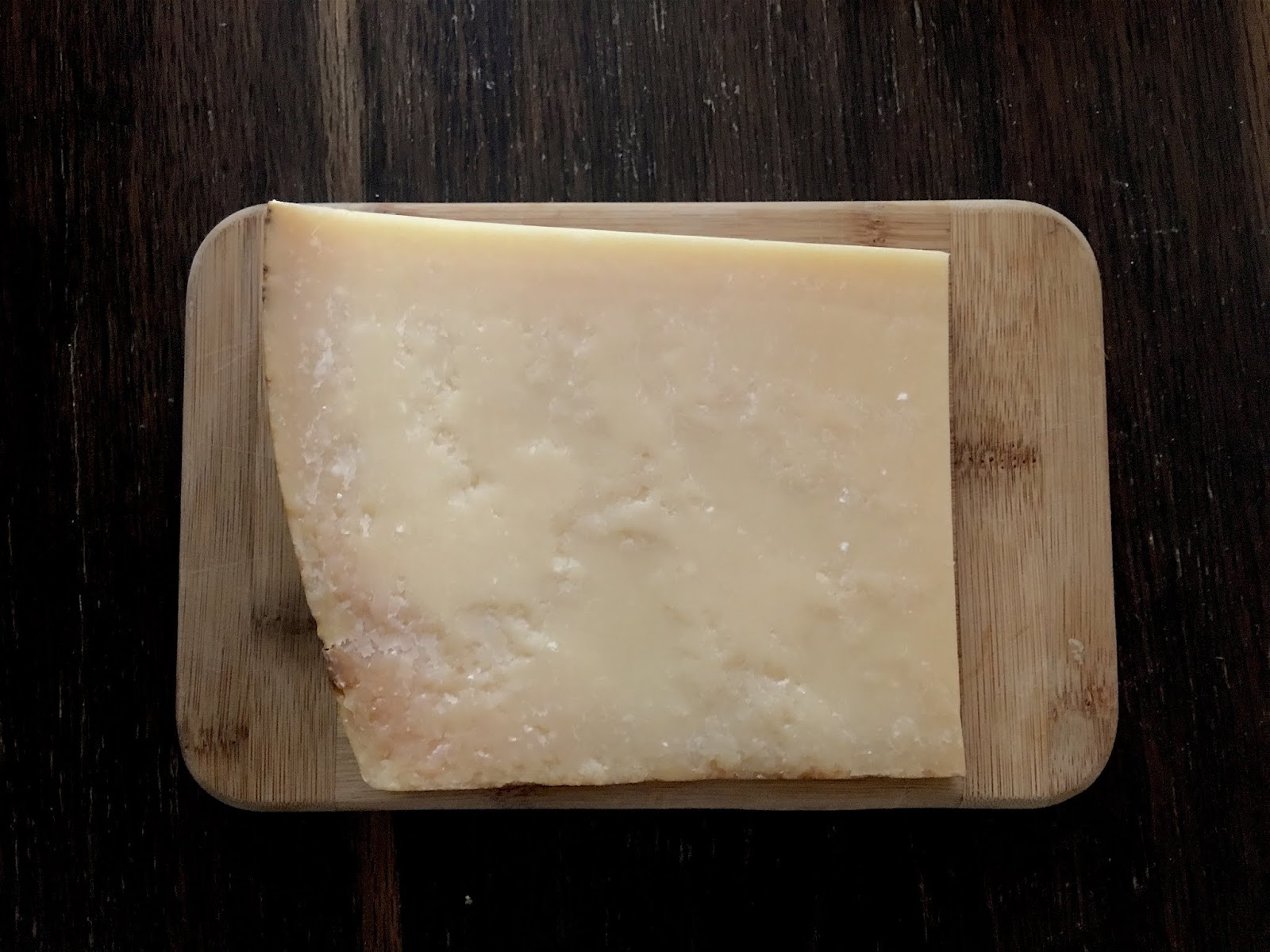
Thoughts: Ok. So you’ve had Parmigiano Reggiano before. Cool. The big spoiler alert here is that this also tastes… like Parmigiano Reggiano. I mean, it should, because it is that same cheese that you had at 12 months but this one has been aged and flipped with decreasing frequency for another couple trips around the sun. Does it taste more… intense? Yeah, probably. How often do you just eat a plain slice of Parm? A little goes a long way. A lot goes a long way, too. Too much probably goes all the way to the hospital. This is not health food, no matter how pretty it looks on your Insta. Of course the flavor of the 3 Year is somewhat more concentrated, the texture noticeably drier, and the bite of that unpasteurized milk ever present. The truth is, dear reader, we tore into it like it was our last day on earth and didn’t look back. That half kilo of Parma Gold lasted us a good long while and was the star of many an appetizer and pasta dish, but to sit down and describe it today feels… cheap. It deserves poetry, it deserves fanfare, it deserves to be hunted down and bought from the kind man behind the counter in the white apron. It’s a good cheese. You will like it.


The train trip through the alps from Germany to northern Italy is absolutely stunning. Even if the destination wasn't a wonderland of freshwater lakes and mouthwatering delicacies, which it definitely is, the ride itself would be a worthy vacation.  


Monday, January 7, 2019

Keens Traditional Unpasteurized Cheddar, A Story of England


Great News! 

My last encounter with West Country Farmhouse Cheddar left me feeling a little over-sold and underwhelmed. This was likely no one’s fault but my own, buying as I did such a cheddar wrapped in black wax and shipped over an ocean. Today’s cheese, however, is really turning the page on cheddar in general and West Country Farmhouse Cheddar in specific. I’m not sure anyone anywhere was really waiting for this particular reputation to be redeemed, but here we go anyways. 

Keens Traditional Unpasteurized Cheddar. Wouldn’t you know it? It is all of those things. Let me take you on a journey now, to a magical land. The sound of the subway, the glare of the florescent lights, the smell of coffee on that guy’s breath, it’s all fading away. In its place is a world of hedgerow-lined roads barely wide enough for one car, thatch-roofed pubs promising ‘good food and real ale’, and a lot of people calling me ‘boss’. Yes, England. I honestly did not know what to expect from this quick weekend trip, my first to England. A friend’s wedding meant seeing some familiar faces and a rental car meant getting to explore south-west England on the day before the wedding. This day was full of surprises. Not only did I not get into an accident from driving, but the weather was gorgeous and the food was delicious. We set off after breakfast for a day of sightseeing and cheese, full of bacon and beans and egg and fried bread. It could only be a good day. Like any responsible cheese traveler I’d done my homework and found out, to my great delight, that the wedding and reception (and our overnight stay) were pretty close to Cheddar country in England. West Country Farmhouse Cheddar, as you might remember, can only be made in a few counties in England. Fortuntately, the website of the group that maintains this tradition is very informative and gave me an address at which to buy some of this famed curd. 

One visit to a large stony tourist attraction later, we piled out of our rental car in the small parking lot of a farm. I had somehow thought there would be a place sit and get some lunch, maybe tour the dairy, but what we found was better. Doing the classic “we don’t know where we’re going, we are not from around here’ walk, we made our way up to what looked like main buildings. As far as we could tell, the only person around was a fellow smoking a cigarette, seemingly on break from doing some maintenance. Graciously he opened up the dialogue with a knowing ‘you all looking to buy some cheese?’. Yes. Yes we are. This kind man led us to a fridge, industrial in size and build, inside of which we found a beautiful collection of cheese and butter from the farm. Thinking better of buying a whole wheel of cheese (we’re not made of money after all), we bought a half wheel. More precisely, our friends bought us a half wheel of cheddar. You should keep the kinds of friends who buy you cheese. 

OK, enough story time. You’re here for the cheese. Keen’s Cheddar is true farmhouse operation, meaning they have their own herd, grazing solely on their own land. Land which also houses the cheese making operation. This means, as their website proudly states, that they don’t ever have to transport the milk more than 50 yards, that the cheesemaking process begins within 12 hours of milking, and that the unpasteurized milk they use is about as close to the freshness of that English hillside as you can get. They have a herd of 250 Friesian cows, and the entire cheese making process, from stirring and cutting the curd to cheddaring to flipping the wheels while aging is done by hand.  

Origin: Somerset, England
Milk: Unpasteurized cows milk cheese
Rennet: Animal
Affinage: Between 12 and 18 months

Ah England, where it is always this sunny

Notes: An unassuming little wheel of cheese. The half wheel we got had a lightly textured rind with the pleasant grays and tans of a natural rind. From appearances it is not quite like other cheddars I’ve had, neither the clear calcium crystals of the more aged cheddars nor the rubbery texture of lesser cheddars. Smells like a raw milk cheese, a promising straw-white colo(u?)r and hints of the kind of strata that you get in an extra aged Gouda. 

Thoughts: That it is a raw milk cheese is apparent from the first, indeed this cheese is almost tart as it first hits the tongue, the acidity of the milk never having been blasted away or blended out on a commercial scale. It’s also chewy, almost in the way that cheese curds or Halloumi are chewy. At first I was afraid the cheddar was going to be too dry, lacking in that satisfying fatty rush usually associated with whole milk cow cheeses. Nor is there the usual glut of salt, a hallmark of most cheddars. To be honest, I actually look forward to this combination when I get a good cheddar, or even a bad cheddar, because salt and fat pretty much sell themselves as a flavor combination. That said, Keens Cheddar does not disappoint so much as it proudly stands for what it is, a Cheddar in a class of its own. All of the textural and flavor notes change moments after the first bite, washing the palate in a complex richness. This stands out in comparison to other cheddars, other very good cheddars, in that the tasting notes are recognizably cheddar but unlike anything I’ve had before. Perhaps this is the Westcountry Farmhouse Cheddar difference? For example, there is no horesradish in this cheese, and yet just before the wave of rich nutty sweetness hits you get a tickling of the tip of the tongue of just that; horseradish. This is also the most notable flavor in the aftertaste, which is delightful. 


Week 2 of the relaunch! This is a 100% improvement on my previous streak in the past 6 years. Going to go eat some celebratory cheese. 


Tuesday, January 1, 2019

Mont d'Or, or 'The Return of the Functioning Cheese Addict'


This cheese is legend. There is no comparison. There is no replacement. You may not have known there were rich veins of gold in France, but this cheese is proof. I would truly rather have this cheese than the equivalent weight in gold. Why? Because you can’t dip fresh baguette into gold and eat it hand over fist until yesterday, today, and tomorrow blend into a gastronomic experience unmatched this side of michelin star restaurants and epic myths. 

Fresh from the oven!

Origin: France and Switzerland
Rennet: Animal
Milk: cow, unpasteurized
Affinage: ~6 weeks

Notes:
This cheese is also known as Vacherin du Haut-Doubs. The rind is washed and wavy, but the smell while strong is not offensive. This is a mostly seasonal cheese, to be made and eaten in winter. One classic preparation is to slice small slits in the top of the rind and insert slivers of raw garlic, add a splash of white wine, and bake in the oven until melted through and bubbling. This is what fondue wants to be when it grows up. 


Thoughts:
Even without the garlic, even without the white wine, this cheese has layers of flavor like a good dog has wags. Sautéed onions and garlic, cream, pot roast, yes pot roast. This cheese is truly among the few that could ever convince me to give up my carnivorous lifestyle, so rich and hearty and satisfying is the mixture of salt and fat hidden in this soft orange rind. The raw milk, assuming your version like mine is made with raw milk, is also a delight, tickling the nostrils like a fresh breeze rolling down an alpine meadow. These cheeses come in various sizes and it is definitely no pushover, but of everything I saw on the christmas party buffet that evening the only thing I really wanted more and more of was this cheese. It is more tempting than the sweetest dessert, more intoxicating than the headdiest punch. This cheese can be hard to find in stores, partially because of its seasonality and partially because it is a raw milk cheese. If you do chance upon one, though, buy first and ask questions later. You will not regret it!  


Hello Dear Readers,
So let's address the proverbial 800lb wheel of Parmigiano Reggiano in the room. It has been a little while since I've written anything about cheese, much less cheese culture and the coming cheese revolution. What happened? Just the usual. Met a girl, settled down, moved abroad, settled down again. That, plus a catastrophic flood, a new job, and all of the other slings and arrows that seven years bring. Although I stopped writing about cheese I've never stopped loving and chasing after it, and so in a year that promises to bring a great many new changes I bring you this humble re-launch. There is a new Instagram to follow (@TheFunctioningCheeseAddict), and yes even some new cheeses! Look for them new every week. 


Tuesday, September 25, 2012

Langres, (Lan)-GREY-sah. Just kidding, I have no idea.

Dear Reader,

Long have I been gone from the bandwidth-bound halls of the blogonet, and far have I travelled. I return now for those hopeful ears still checking this site like a cold war spymaster keeping the back channels open and waiting for the wall to fall. I'm not sure my analogies have gotten any better, but that little segway was meant to signal my change of location. I'll give you a hint, some ill-advised people built an ill-advised wall and it's neither Palestine nor any of the southernmost US states. Also the wall is gonzo. While that brain-teaser teases your brain, let me tell you about today's cheese. I have honestly no idea how frequently these posts are going to come out, but I'm going to savor writing it so I hope you at least mildly enjoy reading it.

In keeping with my new top-secret location, today's cheese is available in it's true form only in Europe (dang, my loose lips have loosed a clue!). For those of you familiar with this blog, me, or cheese (funny how they are interchangeable here...), it will be clear that this is an unpasteurized cheese. Furthermore it's French. I'm not in France. I don't speak a word of the language that doesn't describe curdled milk. Hailing from the high pastures of the Champagne-Ardenne region, it's a stinker. I'm sitting at this very moment nose directly above a cut of it, and it has a definite aroma. Smells like a thousand million tiny little bac-teria encouraged by repeated baths in a brine solution munching away at a Penicillium Camemberti feast. Flowers are overrated Langres is not.
Origin: Champagne-Ardenne, France
Milk: Cow, unpasteurized
Affinage: 4-8 weeks
Rennet: Animal
Notes: Mine was on the younger side of Langres, and was still pretty much intact. On the near side of 8 weeks it'll be a sloppy, glorious mess. Colored with annatto, aged in damp vaults, and occasionally bathed in Champagne, this cheese has everything. 50% fat per solid content, AOC protected, super delicious.
Thoughts: For all its intense smell the flavor is not at all harsh. That is not to say it lacks flavor, though, far from it. The smallest morsel has more notes than you'd find in a modest three course meal or middle school rendition of Hot Cross Buns. The snow-white paste in the center has texture and spring, and leads you on a wonderland of flavor, never peaking but also never dying. The creamy richness parades mushroom, hay, hints of garlic, and something that I can only describe as the damp interior of a cheese aging shack. Because that 1) is so universally appealing 2) so universally relate-able. The creamline and the washed rind add some spice, waking up the back of your palate and then bathing it in heavy cream. I seem to be digging deeper. Oh well, if you're reading this blog at all you have the best chance of the whole world to find these descriptions even slightly appealing. The rind is unlike most any washed rind I've tried before, truly working with the rest of the cheese and just layering on the textural and flavor highlights with hints of bacon and just enough bite to remind you that you're consciously eating something and not just awash in a cheesy dream. Eat it. Eat it right up.

Get this. Here I am walking around the streets of (spoiler alert) Berlin when I see a specialty Italian foods store. Flush with confidence after my recent purchase of today's cheese I enter the establishment and ask the stout yeoman behind the counter about his wares. He proudly shows off 4 or 5 Italian cheeses that I could find you at your local King Soopers or Shaws. Unswayed I ask him if he carries any buffalo cheese, something the Italians do even better than impractical exotic super cars with unreliable electronics. He shows me a plastic-sealed (see supermarket brand) ball of Mozzarella di Bufala di Campagna. Feeling that I'm treading dangerously close to a certain Monty Python script, I ask him if he carries any other buffalo cheeses, having tried at least 4 myself and blogged about as many as well. He tells me in his best German customer service tone that there are no other Italian buffalo cheeses. I then shot him through the head. A joke you too will get if you watch the linked video. Or if you, like me, have already memorized it.  


Monday, January 23, 2012

Morbier, Morbi-HEY!

Dear Readers,  
They rhyme, you see. 
A lot of you folks might have heard of this particular French specialty, but I just realized I had not yet shared it with you, my internet friends. Here it is. Morbier
It is in fact pronounced morbi-yay, which makes it one of the happier and more joyful cheeses out there. It gets its characteristic streak of ash from a little story of old. Back in the day they would take the morning milking and layer those curds into the bottom of the form, and then cover that with a layer of vegetable ash to preserve it throughout the day. That evening the second milking would go on top of the first, giving the final cheese a layer of ash with both form and function. These days they do it just to keep up the tradition, but we like it anyways. The same ash system is seen in modern cheeses such as Humboldt Fog, and it is pretty sexy. You know, for a cheese. 
Origin: Franche-Comté, France 
Milk: Cow, raw or pasteurized
Affinage: up to 2 or 3 months
Rennet: Animal
Notes: Part-Skim milk, and the sweet aroma and yellow-orange rind of a washed-cheese.
Thoughts:  This cheese is mild at first but the creamy goodness develops into a delicious semi-soft morsel. The flavor is meaty and not as harsh as some French cheeses, and although the smell is definitely that of a washed-rind the bark is, as always, worse than its bite. There is a lot of differentiation among brands here, so make sure you are a diligent cheese shopper. Ask that stout yeoman, demand a sample, give it the old smell-test. If it doesn't smell like much, you don't want it. This is a cheese to be warmed up, served with some salami and bread, and washed down with a hearty red. Or pop, I don't know. 

The cool dairy kids use volcanic vegetable ash. From them volcanoes. Truth.    

Saturday, January 21, 2012

Beecher's Marco Polo, Marco, Polo, Marco, Polo, Marco

Rarely do we find cheeses named for popular pool playtime activites, but here is one such cheese. To be perfectly frank I can't decide if their naming method makes the most sense to me. Their website credits the great explorer for bringing spices and peppercorn back to the Old World, but we don't call all fur products Lewis and Clarks, or all... all... there's a Christopher Coloumbus joke to make here but I feel like it'd be in bad taste.
Fortunately, what's in good taste is this cheese. Beecher's Marco Polo is a rare exception to my rule of no shenanigans in my cheddar. By shenanigans, of course, I mean things that aren't milk, rennet, salt, or starters. This would usually include black peppercorns and most certainly includes peppers, garlic, horseradish, and, heaven help us, maple smokiness of questionable origin. In the case of Beecher's, though, the cheese is already so good that they get away with it. 
Origin: Seattle, Washington, USA
Milk: Cow, pasteurized
Rennet: Animal
Affinage: 4-6 months
Notes: Milled green and black peppercorns from Madagascar. Perhaps not the most locavore of choices, but true enough to its name. So.... check that one off the bucket list.... eat Madagascar peppercorns. Yup.
Thoughts: Sweet and nutty are immediately met with the dark and spicy notes from the peppercorn, but no one flavor ever overpowers the other. The rich and almost chocolatey nature of the cheddar is the perfect match for the spice of the peppercorn, and the already delectable texture of their cheddar is only highlighted by the occasional crunch. The aftertaste is one of a slight heat, peppery of course but deliciously so, and overall the cheese proves that flavors can be added without making the entire experience dull, heavy, and boring.


Mad Men is like miracle gro for the old man in me.