Showing posts with label Gouda. Show all posts

Saturday, October 29, 2011

Ewephoria, See What They Did There?

There are some traditions as old as the hills. 
The Gouda masters of Holland are the keepers of some such traditions, and naturally they are the last word on Gouda production. This cheese is not one of those traditions.
Aimed pretty shamelessly at the export market, Ewephoria joins the ranks such as Soignon goat brie and Cambozola in letting flavor follow market demands. While those two cheeses are mediocre if forgettable Frankensteins (or Frankenstein's monsters, if you're a purist), Ewephoria is actually pretty good. You know, dear reader, how I protest against such prostitution of palate for profit, but here's one example that stumbles upon a decent idea and executes it brilliantly. 
Origin: Holland
Milk: Sheep, pasteurized
Rennet: Microbial
Affinage: 6-12 months
Notes: There are a few different ages available, but who are we kidding. Why go for mild and meh when you can have a Gouda that screams unintelligbly in Dutch at you. Doesn't that sound like more fun?
Thoughts: This adaptation on Gouda has a pleasant flavor that develops over the course of the taste. At first the cheese starts out with a mild nuttiness and a hint of sweetness, by the end the sweetness has developed into a rich and dark toffee/butterscotch note that breaks down perfectly on the palate. This sweetness is highlighted and contrasted by the natural oiliness of the sheep's milk, which makes for a complex but not overbearing overall taste. Not too creamy, but balanced, this is a great interpretation of the classic Gouda and well worth trying for any Gouda lover. 


What is fascinating is the contrast between the characteristics of sheep's milk from Spain and that from Holland. I mean, barely 1,000km apart and they could be two completely different animals, for example there is nothing olive-oily about this cheese, but you can practically taste it in a lot of the Spanish sheep's milk delicacies. Does no one else find this really exciting? Am I all alone in the universe?


Monday, August 8, 2011

Midnight Moon, Out Of This World

It is that time again, when I make terrible puns in the title and am too tired to go back and filter them out.
Actually, it's the time when I get to review a cheese that comes from one of my favorite creameries; Cypress Grove. I've already broke the news about their exquisite creamline through the lamb Gouda Lamb Chopper, and today we have a cheese that is, in my mind, even better.
Midnight Moon was first shown to me by a fellow cheese lover at a cheese party in Boulder, but little did I know that it was in fact crafted with love an ocean away in Holland. It is one of my all time favorite cheeses, indeed one of the best goat cheeses ever, an assessment I would defend to the bitter end. 
Origin: Netherlands
Milk: Goat, pasteurized
Rennet: Vegetable
Affinage: Somewhere between 4 and 7 months, the folks at the dairy weren't too keen to share their secrets.
Notes: They import this stuff as fast as it's made, but it still can't keep up with demand. That. Good.
Thoughts: There is not enough to be said about this cheese. The flavor starts off pretty mild but quickly propels itself to a very meaty very nutty delight. The cheese is firm but incredibly creamy, and there are the little crunches that are so great. The flavor of the goat cheese is there from the start and grows and grows as the cheese breaks down in your mouth into tangy perfection and the meaty tones come though like a symphony of flavored delight. Everything about this cheese works and the aftertaste leaves you dying for more, just an incredible goat cheese. If I could keep a wheel of this on hand it would never be far from my plate. 

Random Thought to Further Burden You With
I might just buy a wheel of this, just to never have to rely on timely import shipments again. If I do, you know where the party is: Casa de Functioning Cheese Addict  

Monday, July 25, 2011

Beemster, Because Gouda Actually Is Underrepresented

It is a sad day, to be sure, but though the cheese-a-day program is no more do not fear, good cheese is still out there and I'm still reviewing it. Today especially because I've found a good cheese that you can actually find in the US (if you happen to be reading from the US) rather than some fancy local curd that isn't shipped more than a couple miles from where it's made. 
Beemster is a Gouda that takes being a Gouda seriously. That's about all I've got for you in the way of silly introductions today. 
Origin: Holland
Milk: Cow, pasteurized
Rennet: Animal
Affinage: No less than 18 months
Notes: Made with milk from cows that graze below sea level. Deep stuff, man. Deep stuff.
Thoughts: Although mass produced, this is not a half bad gouda. It is sweet and nutty, with a flavor just dark enough to perfectly usher in the savory aftertaste. If anything this cheese is too gouda, to the point where no one characteristic stands out or is exemplary, just intense. The creaminess works with the flavor and texture, and just enough of that casein crunch to keep things interesting. A solid aged Gouda which should also be easy to come by on supermarket shelves in the US make for the cheese equivalent of Sour Patch Kids. Available all over, strong in flavor but addictive so you'll almost certainly get sick eating it, and I've brought it into a movie theater as a snack hidden in my jacket. 


Caution
You've got to ask yourself one question: "Does he love cheese that much?" 

Friday, July 1, 2011

Marieke Gouda, from Holland's Family Cheese LLC of Wisconsin

Usually I would judge such naming tactics as misleading and a shameless ploy to dupe customers into thinking they're buying a product from well, Holland, but the folks at Marieke Gouda get a pass. You see, they're a first generation family from Holland, using techniques they learned in Holland to make cheese in Wisconsin. Not everyone has the credentials to back up such a name, so be vigilant.
They also have one of the most fluid websites I've seen for a cheesemaking operation, detailing how they left Holland in 2002 looking for room to expand their dairy operations. Expand they did, and they now produce award winning cheeses left and right. Center, too.
Now, I would add the caveat that they produce what's essentially one cheese in 13 flavors, but when your cheese is Marieke Gouda and has risen from nothing to nationwide distribution in less than five years you do what you want.
Origin: Wisconsin, USA
Milk: Cow, unpasteurized
Rennet: Animal
Affinage: A "mittelalt" Gouda, I'd say around the 6 month mark
Notes: I had never quite realized how fiercely proud Wisconsinites are of their cheese. If you'd like to see just how seriously they take their curd check out The Cheese Underground
Thoughts: Although this gouda does not look impressive, in fact the piece I bought didn't look very appetizing at all, it is actually a solid, perhaps even outstanding, cheese. After first biting in the flavor is instantly creamy and builds up to a solid nutty and rich savoryness with a hint of the grassy goodness. You know the one. The standard sweet and lip-smacking aftertaste is present and rounds out a real Wisconsin treat. There are spread out pockets of “crunch” from the casein, always a hit with me, but although the flavor is rich it is not very complex. A great and reliable go-to Gouda that falls in between sensational snacking simplicity and one-of-a-kind masterpiece. 


 Caution
 Hell hath no fury like a Wisconsinite whose cheese has been insulted.  

Friday, May 27, 2011

Double Cream Gouda, Because Normal Gouda isn't Rich Enough

Gouda, good Gouda, is one of the most reliably delicious cheeses out there. You can find Gouda almost everywhere you go, and given that it's typically a hearty and pasteurized cheese it's a rather hard recipe to mess up. Even a bad Gouda may not be a bad cheese, it just may not be anything special, whereas a bad Brie... well you're better off passing up cheese altogether in that case. Gouda may not be particularly fancy or exotic but it is a solid go-to cheese, and now and then the folks in Holland do actually give it a little extra pizazz.
Enter today's cheese: a Double Cream Gouda. There isn't a whole lot of mystery to what the title means, and indeed the only departure from the traditional Gouda recipe here is that cream has been added, bumping the fat per solid content up to a hefty 60%. For what it is, a mass-produced and very commercial cheese, it is good, if a little too true to its name.
Origin: Holland 
Milk: Cow, pasteurized
Rennet: Animal
Affinage: 6 months
Notes: It's easy to discredit a cheese that, to be quite honest, is playing into a market gimmick, but one should not go to Gouda looking for a Rembrandt. It is a simple, honest snacking cheese that has a few notably excellent examples. And, while it may not be featured on many cheese boards in France, it is very good at what it does.
Thoughts: This cheese is certainly rich, and the buttery/creamy paste is actually a little overwhelming. The paste sticks to the palate and melts nicely, very important considering the very young and mild nuttiness that composes the whole of the flavor. This cheese is sweet it's so creamy, and the flavor really is something that anyone could eat without a complaint of pungency, sharpness, complexity..... Ok, so it's not a stunning Gouda, and there are certainly some stunning Goudas out there, but it is fairly clear about what it is from the very name. If you want a cheese that saves you on buying butter, Double Cream Gouda is for you. If you want a cheese to give to the kids to snack on, Double Cream Gouda is for you. If you want an exciting and rich, breathtaking Gouda, keep reading I'll get to them.

Caution
Given that most cheeses, especially relatively young ones like today's, are roughly 50% water; that 60% fat per solid mass does in fact mean that 30% of what you're eating is still butterfat. Snack accordingly. 

Sunday, May 22, 2011

Lamb Chopper, More Than Just a Cool Label

Cypress Grove, who I probably rave about enough to merit a restraining order, is mainly a goat-cheese operation. While it's true that their products coming out of California all use goat milk, they have a secretive and downright delicious side project at an off-shore base that creates two top of the line cheeses, including today's sheep's milk offering.
The location of the base, the lovely region of Holland, may not actually be a secret, but that does not make the cheeses any less exciting. Lamb Chopper is a young to middle aged sheep's milk Gouda that tastes so good you'll forget about the terrible pun on the label. 
Origin: Holland
Milk: Sheep, pasteurized
Rennet: Vegetarian
Affinage: 4-6 months
Notes: Both the cheeses produced in Holland for Cypress Grove are labeled with the Creamline designation and both are Gouda-style cheeses, the other called Midnight Moon being a goat's milk Gouda.
Thoughts: With a flavor strongly reminiscent of a young manchego but less oily, this is truly a strong entry into the sheep's milk category. On Cypress Grove's website they joke that Lamb Chopper was Born to be Mild, here it helps if you followed the above link, and while this is true it's a well developed and nuanced mildness that is sure to please. Sweet and fruity tones captivate at first, thanks to the relative youth of the cheese, and are followed in turn by the more familiar grassy tang of sheep's milk. The end of the taste is a little heavier on the palate than one would expect but the hearty, simple, and straightforward beauty of this Gouda is to be admired. A thoroughly satisfying sheep's milk cheese that avoids the earthy dark flavor of its Spanish cousins in favor of a lighter approach, Lamb Chopper is sure to please and is mild enough to be a great introduction to the world of sheep's cheese.

Caution
Both Lamb Chopper and its brother Midnight Moon suffer from spotty availability in stores due to their far-away origins and the trouble of making such a high quality product. When you see a wheel or a sample of either you would do well to jump on the opportunity and try it, they do not disappoint.  

Friday, April 22, 2011

Goat Cheese and other Exciting Things

So here's the thing.
As it stands I've got enough cheeses already documented to post 4 or 5 a week for the next 9 months, but what fun would that be when we could have a cheese a day for 6 months! Yes yes I know this sounds too good to be true and, depending on my schoolwork over the next few months, it may just be. Still it's worth a shot, so starting Monday you'll be getting your dose of cheesy goodness daily and, as ever, with a smile. More fun news to follow, but you're not here for chit-chatting, jabberjawing, or chin wagging, you're here for cheese.

I've avoided themes thus far because, around the tenth or so "France" themed post for example,  there would eventually be some grumbling among the crowd (however small that crowd may be). I made it a whole four posts before caving, here's to willpower. The truth is I adore goat cheese. It's the closest to a favorite type of cheese that I have and, fortunately for myself and my fellow capercaseophiles, there is an absolute wealth of choices out there. Some better than others, here continues my guided tour of the wide world of goat cheese.

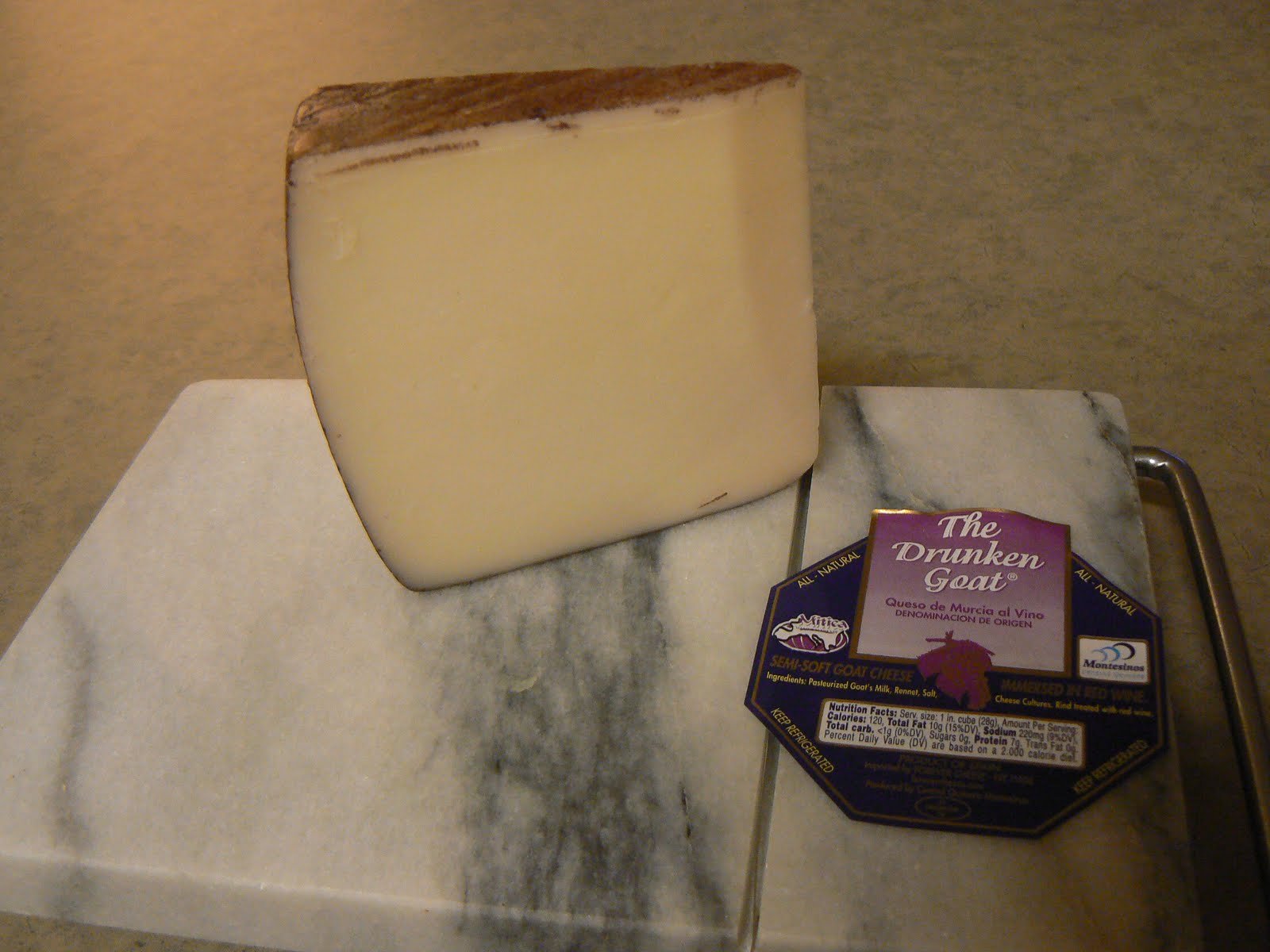
We begin with a selection that the casual goat cheese enthusiast will likely recognize and which is at home on any cheese plate: The Drunken Goat. Hailing from the town of Jumilla in the Murcia region of Spain, this is effectively the gateway drug into the world of wine-bathed cheese.
Origin: Murcia, Spain
Milk: Goat, pasteurized
Rennet: Animal enzyme
Affinage: 75 days
Notes: Soaked in Doble Pasta red wine for 48-72 hours. The cheese, that is. The goat just had a glass. This cheese is also name-protected under Spanish law.
Thoughts: The bone-white, semi-firm paste that is so characteristic of aged goat cheeses is enticing enough, but just upon unwrapping this treat it becomes clear that the vino-bath paid off. The aroma, while not overwhelming, is pronounced and, combined with the purple/brownish coloring that covers the rind and seeps ever so faintly into the paste, will make you start to wonder what else could be improved with 3 days curing in wine. Truth be told the cheese itself is a fairly average, if respectable, example of slightly aged goat cheese. The flavor remains mild from start to finish and the usually pronounced "tang"of the goat's milk is hardly noticeable at all. The texture is well balanced and creamy enough to somewhat make up for the understated flavor but I would trade a drier texture for a sharper flavor. The natural sweetness of the goat's milk does, however, compliment the sweet and fruity tones imparted by the wine bath, leaving you with a cheese that serves as a wonderful introduction to the subgroup of "drunken" cheeses. There are others, such as Irish porter and whiskey cheddars and Italian Ubriacos, but these tend to sour the less adventurous sampler with their intensity. Don't dismay, they're coming.

Drunken Goat gets seven arbitrary units of measurement out of ten, but this next cheese needs no introduction. Rather it deserves no introduction.
Landana Mild Goat
Origin: Netherlands
Milk: Goat, pasteurized
Rennet: Think the drummer from the Muppets
Affinage: 6-8 Weeks
Notes: Unmistakably cheese.
Yessir.
Thoughts: The sad truth is that there just isn't a whole lot to say about this cheese. I recall it was one of the first cheeses I recorded and photographed, distinguished by my short-lived habit of photographing the label along with the cheese, and I remember being generally disappointed to then find myself with sizable block of forgettable cheese. This was back when I was a cheese fiend sans employment, and when the checks aren't coming you can't afford to throw money away on sub-par Käse. The flavor is beyond mild, the only marginally noticeable characteristic being a hint of sweetness. The texture and creaminess would be suitable if there was any flavor to discern, but this the celery of goat cheeses, you'd die of boredom before it filled you up. My advice? Either find some bread and jelly or skip the middleman and just eat the peanut butter off the spoon. Maybe that's a bit harsh, and if you happen to find the black wax label 10 month aged Landana Goat Old do let me know what you think, but there just aren't any redeeming qualities to this cheese. There are lessons to be learned from this:
1) Not all that is imported is made of gold, the Europeans get it wrong too, and
2) Young goat Gouda is no better than young cow Gouda, they both belong on sandwiches not serving platters.

Don't worry, today's third cheese is a standalone rockstar and more than makes up for Landana's lack of character and flavor, but first some more news. The astute Sherlock Holmesian (Dr. Houseian?) reader will notice a new addition on the sidebar; some difficult to read and overly flowery text (I really must fire the intern responsible for all these run-on sentences of late). Directly below that paragraph there is a link to what may be simultaneously the most laughable and most telling sign of my addiction: my quick-reference cheese chart. Once upon a time I was a student of engineering, a well informed decision I made based on 18 years of enjoying playing with Lego, not hating math classes and a dream of one day earning money.  That story ended in tears (I realized I'd rather work with travel and politics than numbers and dirt) but i maintained my tendencies of over-analyzing and over-organizing.

The result is the cheese chart, containing the basic traits of all the cheeses I could find, as best as I could find them. I will admit not every box is checked, but in general the important information is there. A note on pasteurization and rennet type: if you are unsure about either and are greatly concerned, find a cheese you can be certain about. That being said cheese that is not labeled in any way as being microbial or vegetarian friendly can be safely assumed to use animal rennet; it is a big enough selling point that most manufacturers will want to make their animal-friendly ways known. As for pasteurization, international cheeses that do not specify "raw milk" "rohmilch" au lait cru" or "leche sin/no pasteurizar"will typically be be pasteurized, especially considering the legal difficulties with importing raw dairy products. As for domestic cheese, the vast majority will be pasteurized, thanks again to the tastebud-impared folks at the USFDA. Those that aren't will be marked but again, although I personally think the only real danger of eating unpasteurized cheese is having your mind blown in a flavor explosion, if you are seriously concerned then stick to the pasteurized stuff. Pasteurization deserves its own post and will get it soon. 
In any case I hope this resources is in some way helpful to those looking for a fresh French goat cheese or an unpasteurized cheddar or what have you, and of course I am always eager to answer cheese queries and help with pairings, platters ideas, and other manifestations of my addiction. The email address in my profile. PS: if you like the blog so much that you want to know when it's updated feel free to "follow" The Functioning Cheese Addict and make your addiction public as well. That link is also hiding on the left. 


Now for the main attraction, the Titan of Tuber Tastiness, the Giant of Goaty Goodness, here all the way from Cypress Grove Chevre in California; Truffle Tremor. Cypress Grove represents what is  truly the pinnacle of domestic goat cheese production, accept no substitutes. Their lineup is consistently incredible and varies from delicate fresh chevre to perfectly surface ripened gems to the best goat Gouda I have yet tried. Truffle Tremor is one of their more adventurous products but if decadent is what you're after then look no further.  
Origin: California, USA
Milk: Goat, pasteurized
Rennet: Full-fledged, no chicken no fish vegetarian.
Affinage: Up to one month
Notes: This particular specimen is on the older side of the surface-ripened cheese hill, as seen in the size of the creamline (or proteolysis), that bit bit between the soft white rind and the paste. Furthermore this cheese is made with black truffles, or tuber aestivum vittadini. Science Rules!
Thoughts: First of all, if that picture is not enough to encourage you to go out and purchase a wedge right away, well there may just be nothing more I can do for you. Even this rather aged variety maintains a soft and fluffy rind, yes this is one of those rinds you should definitely eat, while also showing how the proteolysis is slowly consuming the bone-white paste. Cheese is alive, true story. That process is the cheese naturally aging, as surface-ripened cheeses are apt to do, up until the point that you eat them, offering a lot of control over how sharp, creamy, and acidic you want your cheese experience to be. Truffle Tremor is a delight at any stage, but in this more mature state it truly defines the word decadent. The paste of the cheese is sharp and very rich, taking full advantage of the creamy goat's milk but maintaining a clean feel. Savory without being the least bit earthy, it combines with the milky creamline and the extra kick from the rind to create a flavor that is complex but not muddled. Throughout all of this is the steady umami kick of the truffles is present and adds yet another dimension of flavor, one distinct but so refined that it almost gets lost in the mix, preferring to remain relatively in the background from start to finish. This cheese is the first to go at parties, it is the favorite, it is All-Star Quarterback Johnny Footballplayer, it is Ms. Overachieving Social Butterfly/Homecoming Queen/Yearbook Editor-in-Chief. Buy a wedge, leave it wrapped up but unrefrigerated for about a half an hour on your kitchen counter, cancel your evening plans, and get your baguette on. 


Caution
The USFDA recommends that pregnant and nursing women and anyone with a weakened immune system avoids unpasteurized milk and dairy products. Your health is ultimately more important than trying every cheese out there, and there are lots of good pasteurized cheeses to be had. 
On the other hand, the US Government also recommends avoiding travel to Bosnia, Kosovo, Albania, Serbia, China, and the Caucasus. Really only one way to find out what all the fuss is about.
Just Sayin'