Wednesday, May 11, 2011

Xynomizithra, The Other Other Other Greek Cheese

Feta.
All I'd hear all day long at work is how great Feta is with this or how wonderful it is with that.
Feta! Feta! Feta!
Yes, Feta cut straight off the block is one of life's purest joys, but what of the other Greek cheeses? Myzithra is a fresh goat and/or sheep's milk cheese often used in cooking and similar in many ways to Ricotta. This is not that cheese. This is the dried, sour milk version of Myzithra, hence the exotic prefix (hey, it's all Ελληνικά to me). Xynomizithra is a Greek grating cheese good on pastas and in cooking alike. 
Origin: Crete, Greece
Milk: Goat and possibly sheep, unpasteurized
Rennet: Animal
Affiange: Many months. Cheese is properly old.
Notes: 15% fat content. One of the first cheeses I tried, hence the expert photography. Learn from my mistake and do not eat it alone, I was so young and foolish then. 
Thoughts: Right, so this cheese is sour like Warheads, but without those awesome sweet-fruity flavors and way less practical for dares. "I dare you to stuff a half pound of Greek grating cheese into your mouth all at once! Double. Dog. Dare you." It just doesn't work. The raw milk flavor also factors pretty strongly here, which just isn't always what you're looking for in a cheese. The unpleasantness is increased by it's chalky texture, which is drier, finer, and more crumbly than a Parmigiano Reggiano. I'll eat Parmigiano by itself, whether for the sheer decadence or the occasional sodium kick, but Xynomizithra doesn't get to be a part of that party. 
This would be a problem if Xynomizithra was really meant to be eaten alone, but it is in fact a grating/dessert cheese. Grating cheese is self-explanatory, but the fun comes with dessert. Want to give your cheese-loving friends a surprise? Offer them some of this Greek specialty by itself first and then in a spoon with a dollop of whipped honey. Compare reactions. Bask in their admiration of your crazy cheese know-how. Together with honey the texture of the cheese is actually pleasant enough and the flavor combination is worth at least trying. Alternatively play it safe and keep Xynomizithra with pasta and Feta with cheese plates.  


Caution
If you understood the reference in the first line you are either 
1) over the age of 40
2) A real
3) One of those people who watches way too much TV-Land

If you didn't understand the reference in the first line, then here's the story of a man named Michael who was busy writing cheese blogs of his own. He had readers stop by every now and then, sometimes from places unknown. If you haven't gotten the theme song yet then ask your parents' help.

Tuesday, May 10, 2011

Taleggio, The Best Grilled Cheese... Cheese

Everyone has fond childhood memories of grilled cheese sandwiches and tomato soup, and if you don't then don't worry you probably just had your memory erased or something. I hear that happens. My memories of this staple meal usually include the Warhol-worthy Campbells Tomato Soup, some sliced white bread, and deli cheddar or swiss, grilled in butter on the stove. Truly delicious.
In the many many years since my childhood grilled cheese has undergone a revolution of its own, from individually intrepid edible entrepreneurs to entire grilled cheese cook-offs. While the crazies in California are putting on costumes and making dessert grilled cheeses, a whole other world of grilled cheeses exists in the Old World. Greece has Halloumi, Raclette has been grilled in the Alps for centuries, and then there is today's cheese. While not traditionally a grilling cheese per se, Taleggio makes for my personal favorite grilled cheese recipe. With Prosciutto, sweet fig jam, and slices of Tallegio, grilled cheese gets taken to a whole new level. I first tried this combination while working at the Cheese Importers and instantly loved it. Just don't dunk it in soup. 
Origin: Lombardy, Italy
Milk: Cow, pasteurized
Rennet: Animal
Affinage: Six to ten weeks
Notes: Right, so it doesn't look particularly appetizing, and it's washed in brine regularly during it's aging process so it is on the, um, full side of the aroma spectrum, but don't knock it 'till you try it. It will change everything.
Thoughts: Like most all washed rind, "stinky" cheeses, the bark of this cheese is significantly worse than the bite. What meets your tastebuds at the first bite is in fact a very mellow, though fully developed, delight. The soft, springy texture has a creamy and milky feel to it but the real flavor is in the salty, meaty tones that build up quickly and remain through to the end. Hints of fruit and nuts come in through the end of this very smooth and medium-bodied cheese, rounding out and adding a very mature dimension to the overall flavor. Given that description one can see how it would pair beautifully grilled with sweet, succulent fig jam and salty, potent prosciutto and... and now I'm hungry.

Caution
I am planning a trip to northern Lombardy, right near the Val Tallegio where this cheese is rumored to have originated. If I stop posting these one day with no warning, you know where to find me. Be advised, I might go straight Colonel Kurtz

Monday, May 9, 2011

Storing and Serving Cheese

Once Again it's The-More-You-Know Monday, and we're picking up with the purchasing of cheese.

Once you've found your slices of the good stuff, you'll want to get it home as quickly as possible. One of the most frequently asked questions at the Cheese Importers is whether or not cheese "x" can afford to be left in the car while the rest of the day's shopping is done. Now, the more intense cheese shopper will have brought his or her insulated "freezer bag" and maybe even a full on cooler with ice, but these are the exceptions to the rule. The truth is that the answer depends on any number of factors and cannot simply be generalized. Helpful, huh?
From the very start of a cheese's life there are processes occurring within the paste and rind, the general aging process if you will. Keeping it in a temperate and humidity controlled state, as any cheese store should, keeps it in the ideal conditions to live as long as possible, but as soon as you remove it from the cold the processes speed up considerably and you risk the cheese turning. As a general rule of thumb, the younger and more fragile the cheese the less time you want to keep it out of the cold. Your Parmigiano Reggiano could last for hours in a ventilated car, your Brie will not necessarily be so lucky. This being said logic is your friend and, on those days where the seatbelt gives you a 3rd degree burn, you'll want to get the cheese home quick no matter what kind it is, but otherwise most firm and semi-firm cheeses have a grace period of an hour or so. It will not taste as good as it would had it never warmed up prior to being served, but it will not have turned.
You should typically try to purchase your cheeses the day that you're going to serve them, again for freshness sake, and if you are so fortunate to shop at a store with it's own affineur, a professional cheese ager, then you will have bought your piece at the peak of its flavor anyways.   
Cheese Saver
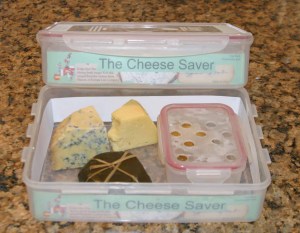
Once your cheese is safely home you'll want to keep it in a similarly controlled environment as is found in a cheese store (or, say, a traditional cheese aging cave... coincidence?). Humidity is actually as important as temperature here, so placing cheese in the more humid vegetable drawer of your fridge is often recommended. Wrapping it in wax paper or a similar breathable paper is far better than plastic, which effectively suffocates cheese and can impart a harsh flavor, but better yet put them in some tupperware, being sure to keep the more "ripe" or blue cheeses separate as they don't play nicely with others. Alternatively the long-term planner might buy a cheese storing contraption such as this (right), but only if you have the fridge space and plan on using it.
Do not freeze cheese. Just don't do it.
Do look forward to putting on an epic cheese party with all of your carefully chosen, transported and stored cheese. Given that you've bought all of this cheese you would be doing yourself a disfavor if you didn't then go and buy just the right accompaniments to best bring out and accentuate the flavors of each. Dried fruit is often a big hit, cranberries and apricots are staples but shelling out for cherries and figs is sure to please. Even the prune has a place on the cheese board. Some cheeses call for fresh fruit and crisp apples with blue cheese or pears with any fruity cheese is a knockout. Nuts can also accompany a wide range of cheeses, walnuts and almonds being a great pair for blue cheese as well. Preserves, ever the conveyors of rich and complex flavors, can also be mated with cheeses to give an old cheese a new twist. More on pairing later, but hands on learning is best so experiment and be bold.

You will, of course want to have a comfortable stash of baguettes on hand as they will almost always run out before the cheese does, leaving guests to get creative (Brillat-Savarin between two dried apricots is actually really good), but cut one or two up into thin slices and arrange them near the soft cheeses especially. Whether you have cheeses and pairings sharing a plate or not is a matter of taste, but if you are unsure as to what will pair best with what it never hurts to have everything separate.
Do make sure that you take the cheeses out of the fridge some time before the party begins to allow them to come to room temperature. A cold cheese will fall short in flavor, aroma, and texutre compared to the same cheese a few degrees warmer. Usually a half an hour is a good average across cheeses, a little more won't hurt either. While your cheese is warming, though, make sure it's still wrapped in wax paper or at least covered somehow, or will dry out in this time and you will have lost a good deal of the cheeses' character. Keep in mind, too, that some brie-like cheeses will spread out onto a plate as they warm up, so plan ahead.
There are a number of ways to present cheeses that make it easier for the guests to know what they're eating, such as grouping them by milk type or country of origin, but these are again mostly matters of preference. What should be paid attention to, however is the intensity of the cheeses. Placing cheeses of similar intensity and/or texture together will help the guests to know what they're getting themselves into and also make issues like sharing knives (a no-no between blues or washed rinds and anything else) less problematic. I've made tiny little toothpick signs for cheese, I've announced cheeses at the start of parties, at the end of the day the more you and your guests know about the cheeses you're enjoying the more involved everyone will feel and the more fun you'll have. Furthermore, and this is a rather large leap of faith into how much the ravenous hordes, host included, can be controlled, the order in which one eats cheese is going to have an effect on how each tastes. The folks at Artisinal Cheese really do a great job in describing the ideal progression from mild and young cheeses to the fierce and spicy blues and washed rinds, the idea of course being that a one hour long aftertaste from the explosive Spanish blue Cabrales will make appreciating a delicate fresh goat cheese a little tricky.
Wine pairing should be done with the understanding that pairing 7 wines with 7 cheeses, while an appealing concept, is rarely practical and would likely lead to a good deal of guests no longer being able to stand up much less appreciate what they're eating. Choose a few that can work with a number of cheeses and encourage sampling, and cheese can in fact be enjoyed without alcohol so there is no shame in popping open the sparkling cider and kicking it old school. 
At the end of the day, if there's cheese, bread, accompaniments, and refreshments enough to go around, the cheese party cannot fail. I like to play classy jazz and such in the background. Some people prefer house and dubstep. Whatever. I like to dress up in vests and top hats and (one day) monocles. No one else dose anything like that, actually. The point is, cheese parties can be whole evening's entertainment, dinner, and education, and what better way to really branch out than have everyone bring some new cheese and try a little of each. Guten Appetit!

Caution
There will always be those clowns who bring blocks of mild cheddar or, mercy, Kraft Singles to a BYOC party as a joke. In certain manuscripts of Dante's Inferno there is reference to a level for just such behavior. In the meantime good old fashioned shunning works pretty well.  

Byaslag, It's From Mongolia

It's not very often that one gets to try a truly bizarre cheese. Even the wildest concoctions from Europe's shores are subject to some sort of regulation and, as such, come with the promise that a stuffy old man or woman somewhere has given it their seal of approval.
It's for the birds, if you ask me.
A friend who shall remain nameless was recently living the life of a modern adventurer and was so good as to bring me back a few specimens of cheese from wildest inner Mongolia. This cheese hasn't seen stainless steel anything, much less a pasteurization machine, and in fact almost everything about it is exceptional. The rennet has been swapped out for kefir, previously fermented milk, the aging process has been swapped for being dried in the sun atop the roofs of houses. Oh, it's also made from primarily Yak's milk. Details beyond this are fuzzy, but fortune favors the bold and if it's good enough for the folks in Mongolia then who am I to turn my nose up at Byaslag.
Origin: Mongolia
Milk: Yak (and possibly cow?)
Rennet: Kefir is used as an alternative coagulating agent.
Affinage: Not aged but dried.
Notes: My piece was still relatively moist, but word has it that the extra-dry pieces are soaked in tea before eating. Add that to the bucket list.
Thoughts: So when I mentioned that almost everything about this cheese was exceptional, I was perhaps bending the truth. For all that makes this cheese truly unique it actually has a very familiar, ordinary even, flavor. A rough balance of creamy and salty start the taste out, building up gently to a sweeter note midway through. Towards the end a marked tang appears and carries on into the aftertaste, but even that has a grassy and sweet flavor that would be easily recognizable as cheese to anyone brought up on a cheddar diet. I would like to say that this cheese makes you imagine you're riding horseback and pillaging the ancient world, but no such bold or unique flavor appears. It was tasty and next time I happen to find myself in Mongolia I'll be sure to pick some up, as should you, but there is a reason exporters are not tripping over themselves to get Byaslag on your local grocer's shelves.


Caution
The USFDA isn't too crazy about you privately bringing foreign agriculture products into the US. Something about invasive species, unidentified bacteria, and T-virus scenarios. Nonsense.  

Sunday, May 8, 2011

Brillat-Savarin, So Good They Named a Man After It

"Tell me what you eat, and I will tell you what you are" -Jean Anthelme Brillat-Savarin.

Leave it to the French to pioneer the gastronomic writing genre, sometimes stereotypes just write themselves. When today's hero walked the earth he certainly made his mark as a foodie. Between learning 5 languages, playing as a professional violinist, traveling and living in the US (to be fair it wasn't by choice; he was fleeing the French Revolution), and later serving as a judge back in France, Brillat-Savarin wrote the authoritative work on food snobbery: Physiologie du goût (The Physiology of Taste). For this, along with such quotes as 

"Those persons who suffer from indigestion, or who become drunk, are utterly ignorant of the true principles of eating and drinking"

Brillat-Savarin earned the admiration of another giant in the French food scene; Henri Androuët. When Androuët created a decadent triple-creme brie in the early 1930s he named it after his hero, and so Brillat-Savarin was (re?)born. Another cream-injected, 75% fat dessert brie, this pasteurized cheese can be found with relative ease in the US and I've yet to meet anyone who's not a fan. 
Origin: Normandy, France
Milk: Cow, pasteurized
Rennet: Animal
Affinage: This cheese is ready to eat just as soon as the curd "blondes up", or becomes a smooth and sturdy paste. The process of getting it to America means you'll be lucky to find it in the 1-2 weeks stage, but it will be delicious at any age. Just avoid any dead pieces, identifiable by discoloration or a slimy rind.
Notes: When one comes across a rich, intense flavor such as Brillat-Savarin one must find other similarly bold flavors with which to pair it, lest the one overshadow the other. My advice for this cheese "confection" is to find the biggest, ripest, sweetest strawberries around, cut them in half, make a Brillat-Savarin-strawberry sandwhich, and then drizzle a balsamic vinegar reduction over the lot. You may want to sit down for this. 
Thoughts: My notes from when I first tried Brillat-Savarin begin with "This is possibly the best brie I have ever come across". A sign of inexperience, to be sure it has been dethroned whether or not it ever rightly held the crown, but it did not receive this high praise without grounds. Nor would I hesitate even today to call it one of my favorite all-time cheese, and here's why. The next line in my description reads "impossibly creamy and milky", but even that falls short of fully explaining just how rich this cheese is. The clean, grassy aroma tickles the nose and is also present in the wickedly sweet paste, which you will want to spread on just about anything within reach. At room temperature, or when aged, it gains a hint of complexity with the odd savory tones, but even in its relatively one-dimensional young stage it is an absolute delight and will surely be a hit at any party. A rare example of doing one thing well enough to appease the critics, this cheese was destined for dessert alongside sweet, fresh fruit and a bottle of Champagne.  

Caution
If one day I am murdered with a (famously fatal) cheese overdose, check first to see who's been buying Brillat-Savarin in bulk. Don't worry, though, I would have died happy.